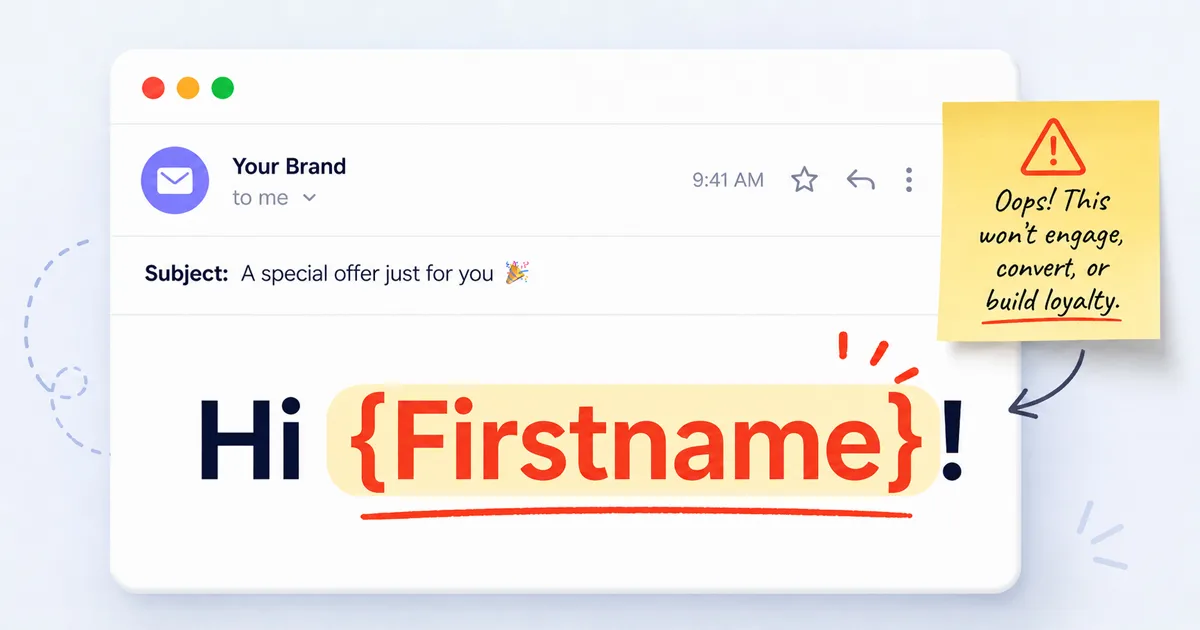
Personalization generates negative experiences for the majority of customers, and most marketing organizations lack the maturity to execute it at scale. The consumer loyalty promise was always overstated: buyers consistently prioritize speed, price, and convenience over tailored experiences. The gap between vendor demos and production reality means the technology rarely delivers what it costs.
Key Takeaways
- Gartner research shows personalization produces negative experiences for 53% of customers, who are 3.2 times more likely to regret their purchase.
- Cart abandonment has held steady at 70% for years despite massive personalization investment, because buyers care more about price, speed, and friction than tailored recommendations.
- 70% of CMOs acknowledge their organizations aren't mature enough to scale AI-driven personalization, yet vendors keep selling it as turnkey.
- The path forward isn't better personalization. It's building customer experiences that make decisions easier, faster, and more trustworthy from the outside in.
The Consumer Promise That Never Landed
The pitch has been remarkably consistent for two decades. Personalize the experience, and customers will pay more, stay longer, and love you forever. Every vendor keynote, every analyst report, every martech conference panel has carried some version of this message. And every year, marketers pour more budget into the tools that promise to deliver it.
The problem isn’t that personalization technology doesn’t exist. It does. The problem is that the consumer half of the equation was never what the industry claimed it was.
Gartner surveyed 1,464 B2B buyers and consumers across North America, the U.K., Australia, and New Zealand in late 2024. The findings should have landed like a grenade in every martech vendor’s quarterly business review : personalized marketing generates negative experiences for 53% of customers (1. Gartner, 2025). Not neutral experiences. Not underwhelming experiences. Negative ones. Those customers were 3.2 times more likely to regret their purchase and 44% less likely to buy from that brand again.
Now put that in front of a CMO defending personalization ROI to the CFO. You invested seven figures in a personalization engine. More than half of the customers it touched had a worse experience because of it. And a meaningful percentage of them are now less likely to come back.
The Gartner research does surface a paradox: customers exposed to personalization were 1.8 times more likely to pay a premium. That’s the number every vendor cherry-picks for the case study. But those same customers were simultaneously far more likely to feel overwhelmed by the volume of information they received and rushed into a decision (1. Gartner, 2025). The premium comes packaged with pressure, cognitive overload, and regret. That’s not loyalty. That’s a transaction that leaves a bad taste.
Audrey Brosnan, Senior Director Analyst at Gartner, put it plainly: “While personalization has proven to be commercially valuable for some customers, it’s crucial to recognize that it doesn’t resonate with most.”
What Consumers Do
Baymard Institute has tracked global cart abandonment for 14 years across 50 independent studies. The current rate: 70.22% (2. Baymard Institute, 2025). Seven out of ten shoppers who add something to their cart leave without buying. That number has barely moved in five years, up 0.65 percentage points since 2020. Billions of dollars in personalization, recommendation engines, dynamic content, and AI-powered journey orchestration , and the aggregate needle hasn’t budged. The industry’s best defense is counterfactual: maybe abandonment would be worse without personalization. But when you’re spending billions and your metric hasn’t improved in five years, the burden of proof sits with the people writing the checks, not the skeptics.
Why do people abandon? Baymard’s data is unambiguous: 48% cite extra costs (shipping, tax, fees). The next two reasons are forced account creation and slow delivery (2. Baymard Institute, 2025). The top three reasons are price, friction, and speed. Personalization doesn’t appear on the list. Not in the top five. Not in the top ten.
Deloitte’s 2025 Consumer Loyalty Program Survey reinforces the pattern from a different angle. Surveying 5,564 U.S. adults, Deloitte found that 4 in 10 Americans now exhibit deal-driven, cost-conscious, or trade-down behaviors across industries (3. Deloitte, 2026). Price, value, and quality remain the top drivers of brand loyalty across every age group and income bracket. Not personalization. Not tailored experiences. Not being recognized by name in an email subject line.
And here’s where the loyalty narrative collapses entirely: the average consumer enrolls in eight loyalty programs but actively participates in only five. At the industry level, the majority of respondents engage with one program (3. Deloitte, 2026). Consumers aren’t ignoring personalization because they haven’t experienced it. They’re ignoring it because it doesn’t deliver enough value to hold their attention.
The industry has spent two decades telling itself that consumers want to be known. Consumers want to be served. Fast, cheap, and easy beats tailored every time, and the data has been saying this for years.
The Stack That Can’t Deliver
Set aside the consumer argument for a moment. Assume, charitably, that personalization at its best could create meaningful differentiation. The next question is whether your stack can execute it.
For most organizations, the answer is no. Not because the features don’t exist, but because the gap between buying a personalization capability and running it in production is enormous.
Gartner’s 2026 CMO Spend Survey, covering 401 CMOs surveyed between January and March 2026, surfaces the readiness gap in stark terms. Seventy percent of CMOs say becoming an AI leader is a critical goal for 2026. Seventy percent also acknowledge that their internal marketing processes are not yet mature enough to effectively implement and scale AI (4. Gartner, 2026). Only 30% report mature or fully developed AI readiness capabilities.
That’s a structural admission: seven out of ten marketing organizations, by their own leaders’ assessment, aren’t built to scale the technology they’re actively buying. And the budget pressure compounds the problem. More than half of CMOs say their organization lacks the budget required to deliver their 2026 strategy, with marketing budgets remaining effectively flat year-over-year (4. Gartner, 2026). More ambition. Same resources. The math doesn’t work.
Apoorv Durga, Vice President of Research at Real Story Group and a two-decade veteran in marketing technology, has been documenting the pattern for years. RSG’s research consistently shows the same structural trap: teams start with channel silos. One personalization engine in the CMS, another in email, a third in the mobile app (5. Real Story Group, 2025). Each channel operates its own decisioning logic. Customers experience disjointed interactions that feel more like automation than genuine personalization. The problem isn’t only operational. It’s architectural. When every channel personalizes independently, the customer gets three different versions of what the brand thinks they want, and none of them are coherent.
Durga titled an RSG article what every practitioner already knows but few are willing to say publicly: “The Personalization-at-Scale Myth.” The subtitle: “Let’s be honest: almost no enterprise is doing it” (5. Real Story Group, 2025). In an April 2026 RSG webinar, Durga and RSG founder Tony Byrne extended the argument: marketers have been working on personalization for more than two decades and have frequently been disappointed with the results relative to the effort (6. Real Story Group, 2026).
The practitioner community confirms this in less diplomatic terms. Across professional forums and industry channels, the execution gap follows a consistent script. Tools get purchased and activated. The vendor demo that closed the deal showed a polished experience: a customer arrives, the platform recognizes them, content adapts in real time, the right offer appears at the right moment. Then the implementation begins, and the script falls apart.
Data Latency
Personalization engines promise real-time decisioning. But “real-time” depends on the data feeding those decisions, and most enterprise data architectures don’t operate in real time. Customer data platforms batch-process overnight. Event streams buffer. Profile updates sync on schedules measured in hours, not milliseconds. The result: a customer who purchased yesterday still sees that product recommended today. A customer who called the support line this morning triggers a promotional email that afternoon. The system isn’t personalizing. It’s reacting to a version of the customer that no longer exists.
Identity Resolution
Personalization requires knowing who the customer is across channels and devices, and that has never been harder. Privacy-first browsers block third-party cookies by default. Apple’s App Tracking Transparency forced opt-in. Shared household devices collapse multiple people into a single profile. The unified customer profile that the CDP promised (the single source of truth that makes personalization possible) is riddled with probabilistic matches, merged-and-split records, and ghost profiles that degrade every decision built on top of them. Ask any MOps team how clean their identity graph is. The answer is never “clean enough to personalize confidently.”
Content Operations
AI can generate 500 content variants in minutes. The question nobody asks during the vendor demo is who reviews them. Who ensures brand compliance across 500 variations? Who catches the variant that renders incorrectly on Android tablets, or the dynamic headline that truncates on mobile, or the product recommendation that surfaces an out-of-stock item? Content bloat isn’t a production problem. It’s a governance problem. The tools can generate variations faster than any organization’s content operations can review, approve, and QA them. The human bottleneck didn’t disappear when AI arrived. It moved downstream and got heavier.
The Strategy-to-Operations Handoff
Strategy teams design personalization programs: audience segments, journey triggers, content logic, measurement frameworks. They hand a brief to MOps. MOps discovers the tool doesn’t support that particular trigger condition, or the required data field doesn’t exist in the profile schema, or the integration between the CDP and the email platform has a 48-hour sync delay that makes the journey timing impossible. The program gets simplified, stripped of the conditions that made it interesting, into something the stack can execute. What goes live bears little resemblance to what strategy designed. This loop repeats quarterly, eroding confidence in both the tools and the teams. Eventually, the strategy team stops designing ambitious programs because they know the stack will water them down. The tools become self-limiting, not because of what they can’t do, but because of what the organization has learned not to ask of them.
The tools become self-limiting, not because of what they can't do, but because of what the organization has learned not to ask of them.
None of these are technology problems in the way vendors frame them. They’re operational, architectural, and organizational problems that technology alone can’t solve. And they’ve been the same problems for a decade. The AI layer doesn’t fix them. It sits on top of them.
The Vendor Scale Metrics That Prove Nothing
If consumer behavior says personalization doesn’t drive loyalty, and organizational reality says most teams can’t execute it, you’d expect the vendor conversation to have adjusted by now. It hasn’t. The pitch has gotten louder.
Adobe’s Q1 FY2026 earnings call, covering the quarter ending February 27, 2026, is a masterclass in scale metrics that sidestep outcomes. The company reported that Adobe Experience Platform processes over 35 trillion segment evaluations and more than 70 billion profile activations per day. Subscription revenue for AEP and native apps posted strong year-over-year growth, and AI-first ARR more than tripled (7. Adobe, 2026).
Those are real numbers describing real platform activity. What they don’t describe is whether any of it makes customers more loyal, more satisfied, or more likely to buy again. Zero client-specific ROI metrics. Zero outcome data. The scale is the story because the outcome isn’t.
This pattern isn’t unique to Adobe. It’s the reporting standard across the vendor category. CDP vendors report profiles unified and segments activated. Journey orchestration platforms report journeys triggered and messages delivered. Personalization engines report variants served and sessions influenced. Every metric tracks what the platform did, not what the customer experienced. Activity, not outcome. Volume, not value.
The Implementation Promise Gap
The implementation promises follow the same template across the category. Every major platform promotes low-code or no-code personalization and AI-powered decision engines. The implementation reality involves months of data modeling, specialized consultants, hundreds of hours of configuration, and constant tuning. The feature exists. The frictionless promise doesn’t. CDP vendors sell “unified profiles” available in weeks. Practitioners report six to twelve months before the identity graph is stable enough to personalize against, and even then, the unification rate rarely exceeds 60-70% of known customers.
Adobe’s own FY2025 10-K risk factors tell a different story: everything still requires pristine unified data, complex governance, ongoing QA, and cross-channel testing. The gap between the sales narrative and the compliance disclosure tells you everything about where the vendor incentives point.
AI on Broken Foundations
The AI era has amplified this disconnect, not resolved it. A personalization agent that misreads a customer. A journey agent that floods a churning customer with offers at exactly the wrong moment. An AI-generated content variant that contradicts what the brand said last week. These aren’t edge cases. They’re the predictable consequences of deploying autonomous systems on top of fragmented data, broken processes, and immature governance.
Ewan McIntyre, VP Analyst and Chief of Research in Gartner’s Marketing Practice, framed the danger clearly: “The risk is that CMOs invest in AI tools faster than they build the data foundations, processes, governance and talent required to scale them” (4. Gartner, 2026).
That’s the vendor problem in one sentence. The tools keep getting more capable. The organizations buying them don’t. And the next product launch promises to fix everything the last one couldn’t.
What Would Work
If personalization isn’t the answer, what is?
The MarTech Conference panel in May 2026 offered a useful reframe. Moderator Angela Vega of Expedia Group led a discussion that landed on a conclusion the personalization industry doesn’t want to hear: customers don’t need brands to repeat back information they already know. They need experiences that make decisions easier and interactions more meaningful (8. MarTech.org, 2026).
That’s not personalization. That’s customer experience design, and the distinction matters.
Personalization starts with the brand’s data about the customer and works inward: what do we know, what can we infer, what should we serve? Customer experience design starts with the customer’s goal and works outward: what are they trying to accomplish, what’s in their way, and how do we remove the friction?
What the Evidence Shows
The obvious counterargument is Amazon, Netflix, Spotify. Personalization works brilliantly for them. But those companies built proprietary data platforms, employ thousands of engineers dedicated to recommendation systems, and generate first-party behavioral data at a scale that no typical enterprise can replicate. They’re not buying personalization off the shelf and configuring it with a MOps team of three. Treating them as proof that personalization works for everyone is like pointing to Formula 1 and concluding that anyone can drive 200 mph if they buy the right car.
The Baymard data makes this concrete. Customers don’t abandon carts because the experience wasn’t personalized. They abandon because shipping costs were hidden, checkout was too complicated, or delivery was too slow (2. Baymard Institute, 2025). Fix those three things and you’ll recover more revenue than any personalization engine will generate. No AI required. A checkout that doesn’t waste the customer’s time.
The Deloitte research points the same direction: up to 40% of a brand’s perceived value is driven by non-price factors like customer service, quality, ease of checkout, and loyalty programs (3. Deloitte, 2026). These are experience factors, not personalization factors. They don’t require knowing the customer’s browsing history.
The Outside-In Shift
Consider what that shift looks like in practice. Instead of a “recommended for you” widget that serves irrelevant products based on a stale profile, invest in search and filtering that work so well the customer finds what they need in two clicks. Instead of an AI-powered email sequence trying to predict the next purchase, build a returns process so painless that customers buy with confidence knowing they can change their mind. Instead of dynamic pricing personalization that erodes trust when customers compare notes, publish transparent pricing and shipping costs upfront so there are no surprises at checkout.
None of these require a seven-figure martech investment. None depend on unified identity graphs or real-time segment evaluations. And every one of them targets the actual reasons customers leave, the reasons Baymard has documented for 14 years that personalization vendors have systematically ignored because there’s no recurring license revenue in “make your checkout less annoying.”
This is the outside-in shift. Instead of investing in increasingly sophisticated tools to guess what individual customers want, invest in making the experience so good that individual targeting becomes less necessary . Speed. Clarity. Fairness. Ease. These aren’t personalization outcomes. They’re experience fundamentals.
The scale is the story because the outcome isn't.
The evidence is now overwhelming: the consumer promise that justified two decades of personalization investment was always overstated, the execution reality makes delivery nearly impossible for most organizations, and the vendor metrics that claim progress measure activity, not outcomes.
The path forward isn’t more personalization, better AI, or bigger platforms. It’s a fundamental reorientation toward customer experiences that earn loyalty by being genuinely useful, not by being tailored.
That’s a bigger conversation, and it deserves its own treatment. Because if the demolition in this piece holds, the follow-up question is the one that matters: what does remarkable customer experience look like when you stop filtering it through a personalization lens?
Frequently Asked Questions
Why does personalization create negative customer experiences?
What do consumers actually prioritize over personalized experiences?
Why can't most organizations execute personalization at scale?
Does AI solve the personalization execution problem?
Why do vendors keep promoting personalization if it underperforms?
What's the difference between personalization and customer experience design?
How should CMOs reallocate personalization budgets?
Is all personalization a waste of investment?
References
- Gartner. (2025, June 3). Gartner Survey Reveals Personalization Can Triple the Likelihood of Customer Regret at Key Journey Points. Gartner Newsroom. https://www.gartner.com/en/newsroom/press-releases/2025-06-03-gartner-survey-reveals-personalization-can-triple-the-likelihood-of-customer-regret-at-key-journey-points
- Baymard Institute. (2025). 50 Cart Abandonment Rate Statistics 2026. Baymard Institute. https://baymard.com/lists/cart-abandonment-rate
- Deloitte. (2026, January 12). Reshaping loyalty programs in an era of value seeking. Deloitte Insights. https://www.deloitte.com/us/en/insights/industry/retail-distribution/reshaping-customer-loyalty-programs.html
- Gartner. (2026, May 11). Gartner 2026 CMO Spend Survey Finds CMOs Allocate 15.3% of Marketing Budgets to AI, But Only 30% Are Ready to Scale AI Capabilities. Gartner Newsroom. https://www.gartner.com/en/newsroom/press-releases/2026-05-11-gartner-2026-cmo-spend-survey-finds-cmos-allocate-15-point-3-percent-of-marketing-budgets-to-ai-but-only-30-percent-are-ready-to-scale-ai-capabilities
- Real Story Group. (2025, July 4). The Personalization-at-Scale Myth. Real Story Group Blog. https://www.realstorygroup.com/Blog/personalization-scale-myth
- Real Story Group. (2026, April 7). On-demand Webinar: The Future of Personalization. Real Story Group. https://www.realstorygroup.com/Blog/demand-webinar-future-personalization
- Adobe. (2026, March 12). Adobe Delivers Record Q1 Results. Adobe Investor Relations. https://www.adobe.com/cc-shared/assets/investor-relations/pdfs/21306202/ay45th643t5y46.pdf
- MarTech.org. (2026, May). Creating meaningful moments across the customer journey. MarTech Conference Panel. https://martech.org/creating-meaningful-moments-across-the-customer-journey/