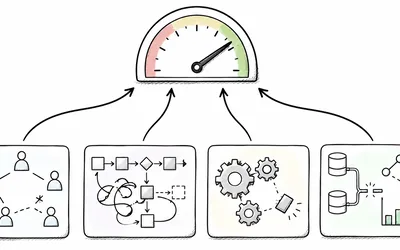
Martech sprawl keeps accelerating after consolidation because the real driver is an ownership gap: your stack shares data, but nobody has decided which tool wins when two disagree. You can buy one platform. You can’t buy that decision.
Key Takeaways
- Consolidating your stack cuts the number of tools. It never decides who owns a customer decision, so workflow sprawl keeps growing.
- Integration means your tools share data, and the market rewards it. Coordination means someone owns the decisions, and no vendor ships that.
- The fix for martech sprawl is an agreement about who owns which decision, not another consolidation project.
- Reality check: that agreement is harder than any migration, because it surfaces the ownership fights your stack was quietly papering over.
Why does martech sprawl keep growing even after you consolidate?
Every consolidation project makes the same promise: fewer tools, less sprawl, a stack you can finally manage. It cuts the tools. The sprawl comes back anyway. The reason is that consolidation solves the visible half of the problem and leaves the expensive half untouched.
There are two different things hiding inside the word “sprawl.” One is the tools themselves. The other is the decisions your stack makes about customers. Integration solved the first half. Your platforms share data now, and the market spent a decade funding that work because everyone could see it. Coordination is the second half: deciding what each tool is allowed to do and which one wins when two of them disagree. That doesn’t arrive in a platform update. So consolidation shrinks the tool count while leaving every decision exactly as unassigned as it was before.
Infrastructure sprawl vs. workflow sprawl: what consolidation fixes
The landscape is enormous, more than 15,000 marketing technology products at last count (1. Brinker & Riemersma, 2026), and every driver you’ve heard is real: the reflex to buy a point solution for every gap, decentralized SaaS purchasing, overlapping features, teams optimizing their own corner without looking sideways.
Consolidation goes after infrastructure sprawl, the raw count of tools and the integrations between them. That work matters and it’s worth doing. But it collapses boxes, not decisions. Workflow sprawl is the number of independent calls being made across your customer lifecycle, and consolidation doesn’t reduce that by one. You can move three teams onto a single platform and still have three teams making three conflicting decisions about the same customer.
The real driver: sprawl is an ownership vacuum, not a tool surplus
Sprawl grows out of an ownership vacuum. Here’s what that looks like in a week: your marketing agent sends a premium positioning email Monday. Your sales agent follows with a discount offer Wednesday. Your support agent fires a win-back sequence Friday because the account went quiet. Same customer data, three goals, and a $200,000 renewal forwarding all three emails to your VP of Sales asking what’s going on over there.
Consolidating those three onto one platform wouldn’t have stopped it, because the tools shared data but never agreed on who decides . Consolidation never assigned who owns the renewal conversation. And this is why the tool count climbs back: each team still owns its own workflow and its own number, so when the consolidated platform doesn’t fit a workflow, someone buys an edge tool that does. The vacuum pulls new tools in.
Why the market rewards integration but not coordination
Procurement funds what it can compare. Vendors know this, so they build capability checklists, API coverage, feature counts, the visible things a buyer can line up side by side in a spreadsheet. Integration fits that model perfectly. It’s measurable, demoable, and easy to justify.
Coordination has no line item. There’s nothing on a vendor comparison for “decided who owns the renewal conversation,” because that decision lives inside your organization, not inside anyone’s product. So the market keeps rewarding the half it can see and price, and the half that stops sprawl stays unfunded. It’s a big reason a connected stack still costs too much and delivers too little .
What actually stops workflow sprawl (and why it isn’t another platform)
The fix is an agreement, and no vendor sells it. For every tool and every agent in your stack, decide three things before it acts: what it’s allowed to do on its own, what it must always do when certain conditions are met, and what it can never do regardless of how the opportunity scores.
Those answers come from marketing, sales, and service sitting down and agreeing on who owns which customer decisions. That’s harder than any migration, because it surfaces the disagreements your stack has been quietly papering over. Technology can enforce the rules once they exist. It can’t write them for you, and no platform ships them in the box.
How AI agents turned a slow problem into an urgent one
Agents multiply the number of things making decisions on the same customer at the same moment, which is why the coordination gap stopped being a slow leak. It’s already showing: 80% of organizations report their AI agents have taken unintended actions, and fewer than half, 44%, have any governance policy for them (2. SailPoint, 2025). Most agents are already acting on their own. Most still have no rule for who wins a conflict. That’s the ownership vacuum, now automated.
The scale is about to jump. Gartner projects the average Fortune 500 enterprise will run over 150,000 agents by 2028, up from fewer than 15 in 2025 (3. Gartner, 2026). Every one of those agents needs the same three decisions defined before it acts, or it makes them for you. Before you approve the next consolidation, write down who owns each customer decision when two tools disagree. If you can’t fill in the names, another platform won’t help.
Frequently Asked Questions
Does consolidating my martech stack reduce sprawl?
What's the difference between martech integration and coordination?
Why do teams keep buying new tools after a big consolidation?
How do you stop workflow sprawl?
Do AI agents make martech sprawl worse?
References
- Brinker, S. & Riemersma, F. (2026, May). 2026 marketing technology landscape supergraphic: Peak martech achieved (maybe). chiefmartec.com & MartechTribe. https://chiefmartec.com/2026/05/2026-marketing-technology-landscape-supergraphic-peak-martech-achieved-maybe
- SailPoint. (2025, May 28). AI agents: The new attack surface. A global survey of security, IT professionals and executives. SailPoint. https://www.sailpoint.com/press-releases/sailpoint-ai-agent-adoption-report
- Gartner. (2026, April 28). Gartner identifies six steps to manage AI agent sprawl. Gartner Newsroom. https://www.gartner.com/en/newsroom/press-releases/2026-04-28-gartner-identifies-six-steps-to-manage-artificial-intelligence-agent-sprawl