Buying martech on features fails because feature comparisons bypass the strategic clarity that determines whether a platform will produce results. Vendors sell features because buyers keep asking for them, creating a procurement cycle that optimizes for demos instead of outcomes.
Key Takeaways
- Feature comparisons reward vendors who demo well, not vendors whose platforms fit your operations.
- Buyers who can't articulate business outcomes default to comparing capabilities they can see.
- Vendors sell features because it's faster than proving operational fit, but the resulting churn costs more than the sale earned.
- Defining what technology must accomplish before evaluating platforms requires internal work most buying teams skip.
The Pattern Nobody Breaks
Every martech buyer knows feature comparisons produce bad decisions. PwC surveyed 767 operations leaders at companies above $100 million in revenue. In 2026, 89% said their technology investments haven’t fully delivered expected results (1. PwC, 2026).
And yet the next vendor evaluation will start the same way: spreadsheet, feature columns, checkboxes. The buying team will sit through demos that showcase capabilities nobody has configured in production. They’ll compare platforms on dimensions that have nothing to do with whether the technology will produce results in their environment.
The dysfunction persists because both sides of the transaction benefit from it in the short term. Buyers get a decision framework that feels rigorous. Vendors get a sales process that favors presentation over fit. The outcomes are terrible.
What Buyers Optimize for When They Buy on Features
Feature-based buying feels rational: identify requirements, score platforms, pick the winner. The problem is where the requirements come from.
Most buying teams can’t articulate what the technology needs to accomplish for the business. Strategic objectives stay vague enough that any vendor can claim alignment. “We need better personalization ” doesn’t guide a platform decision. “We need to increase qualified pipeline from enterprise accounts by 30% through behavioral targeting that our 4-person MOps team can configure without developer support” does. The first statement invites a feature demo. The second invites an operational conversation.
Without that specificity, the evaluation defaults to what’s visible: features. Can it do X? Does it have Y? How does its Z compare to the competitor’s? A contributor to MarTech.org documented the pattern after auditing a mid-sized B2B company’s stack: $850,000 in annual license costs ballooned to $2.1 million when implementation, integration, maintenance, and underused tools were included (2. MarTech.org, 2026). The tools worked fine in isolation. They were purchased without a clear operational plan for what success looked like after go-live.
Feature comparisons also hide capability gaps. A platform’s behavioral scoring looks impressive in a demo. But if your team hasn’t built the data quality , segmentation logic, or governance to feed that scoring engine, the feature sits dormant. You paid for capability your organization can’t activate. The vendor got credit for selling it. Both sides called the evaluation rigorous.
Why Vendors Keep Selling Features
Vendors respond to the incentive structure buyers create.
Feature-selling is faster. Walking a prospect through a capability demo takes 45 minutes. Diagnosing whether the prospect’s team, data, and processes can operationalize those capabilities takes weeks. Gartner’s 2026 CMO Spend Survey found that 70% of CMOs consider becoming an AI leader a critical goal, but 70% also acknowledge their internal marketing processes aren’t mature enough to implement and scale AI (3. Gartner, 2026). Vendors see that gap. Surfacing it during the sales process loses deals.
Feature-selling is also cheaper to scale. A product marketing team can build one demo script that works across hundreds of prospects. Outcome-based selling requires understanding each prospect’s operational reality: longer sales cycles, more expensive presales resources, a pipeline that moves slower.
The cost shows up later. When the buyer discovers that the platform they selected on features doesn’t fit their operational reality, the renewal conversation turns adversarial. The vendor spent heavily to acquire the customer and loses them because fit was never validated. Feature-selling creates a revenue cycle that looks healthy on the front end and bleeds on the back end.
The MarTech.org analysis of vendor selection evolution framed the dysfunction well: RFPs are “designed to sell, not solve.” Weighted scoring systems favor cost and compliance over real-world application (4. MarTech.org, 2026). Change the buyer’s evaluation criteria, and the vendor’s selling behavior follows.
How to Determine What Outcomes Matter
Breaking the feature-buying cycle starts before any vendor conversation. The buyer has to define what the technology must accomplish, and that definition has to be specific enough that not every vendor can claim alignment.
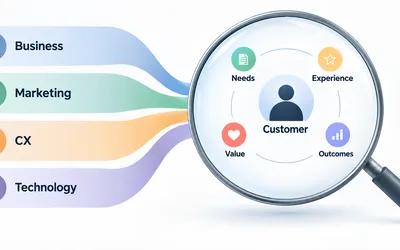
The Marketing Technology Transformation® framework approaches this through four strategic perspectives that technology investments must serve: Business Goals, Marketing Strategy, Customer Experience, and Technology Capabilities. Each constrains the others. Partial alignment fails.
Business Goals establish what the organization strives to achieve. “Accelerate growth” doesn’t guide a technology decision. “Achieve 25% revenue growth through enterprise expansion while maintaining 40% gross margin” tells you whether to optimize behavioral orchestration or rationalize redundant platforms. Strong definitions provide the specificity that technology decisions require. Weak definitions allow any investment to claim strategic fit.
Marketing Strategy defines how your organization creates and captures value. A product-led growth company needs self-service conversion infrastructure. An enterprise B2B organization needs account-based orchestration across long buying cycles. When platforms can’t meet those specific demands, most organizations don’t change the platform. They constrain the strategy to match what the technology supports. That compromise is invisible in a feature comparison.
Customer Experience sets the standards the technology must deliver. Technology Capabilities establishes what’s feasible now and what requires capability building.
When buyers show up to a vendor conversation with this level of clarity, the dynamic changes. The question moves from “what features do you have” to “can your platform produce these specific outcomes given our team’s current capabilities, our data quality, and our operational constraints?” That question disqualifies vendors who can’t deliver, because operational fit is a differentiator that feature parity obscures.
The work is hard. Defining outcomes means confronting capability gaps, strategic ambiguity, and organizational constraints that are easier to ignore when you’re comparing checkboxes. But the alternative is another procurement decision that produces the same underperformance with a different vendor’s logo on it.
Frequently Asked Questions
Why do feature comparisons feel rigorous but produce bad results?
How do I know if my buying team is defaulting to feature-based evaluation?
Can vendors change without buyers changing first?
What's the first step to shifting from feature-based to outcome-based evaluation?
How does the Marketing Technology Transformation framework help with vendor evaluation?
References
- PwC. (2026). Digital Trends in Operations Survey. PricewaterhouseCoopers. https://www.pwc.com/us/en/services/consulting/business-transformation/digital-trends-in-operations.html
- Cain, K. (2026). How a $850K Martech Investment Became a $2.1M Procurement Mistake. MarTech.org. https://martech.org/how-a-850k-martech-investment-became-a-2-1m-procurement-mistake/
- Gartner. (2026). CMO Spend Survey 2026. Gartner, Inc. https://www.gartner.com/en/marketing/research/cmo-spend-survey
- Cain, K. (2026). The Future of MarTech Vendor Selection: Why Pilots Beat RFPs. MarTech.org. https://martech.org/the-future-of-martech-vendor-selection-why-pilots-beat-rfps/