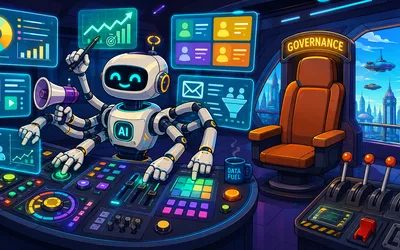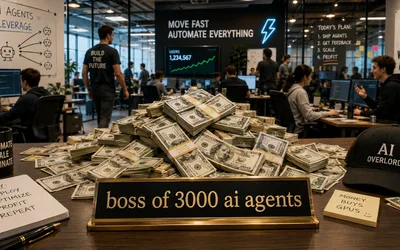
Marketing’s value gap was always an accountability problem, and the one fix that ever worked depended on a named human owning the numbers. Agentic AI removes that human from the work while leaving the accountability question unanswered, which widens the gap it was sold to close.
Key Takeaways
- The one move that ever shifted a CFO's trust in marketing was structural: a named human owning the numbers. Agentic production slides machine-made work between the marketer and that signature.
- Marketing never set up anyone to check machine-made work, because people did the work and a person approved it. Agentic AI exposes that nobody is assigned to catch the machine's mistakes.
- Agentic speed ships campaigns faster than brand, legal, and measurement can verify, widening the gap between rising expectation and provable return.
- Reality check: no tool has ever convinced a CFO that marketing earned its budget. The agent is strong at the cheap mistakes and absent from the one that matters.
Marketing’s value problem was always organizational
Marketing’s oldest problem has a known fix, and agentic AI is quietly dismantling it. The companion analysis to this piece traces eighteen years of the CMO circling one question: can marketing prove its worth to finance? Three waves of technology, analytics then digital then AI, each arrived sold as the answer. None closed it. The conclusion there is that the fix was always organizational, a matter of marketing and finance agreeing in writing on what value means and who keeps score.
That fix carried a dependency nobody flagged. It assumed a human chain of accountability. Someone to define the terms. Someone trusted to keep the score. A name attached to the numbers when the CFO asked who stood behind them. Agentic AI is the first wave to attack that dependency head-on.
The one move that ever worked
Across that whole history, a single move genuinely shifted a CFO’s posture. Mastercard put a finance person inside marketing to prepare and present the return numbers, and those figures carried a credibility that marketing-authored reports never earned (1. BestMediaInfo, 2023). Strip away the org-chart detail and the mechanism is plain: a credentialed human, accountable by name, stood behind the math. The CFO trusted the number because the CFO could see who would answer for it.
What changes when the agent does the work
Agentic AI moves the marketer from producing the work to reviewing it. The agent drafts the campaign, proposes the audience, assembles the attribution story, grinds through the trade-offs a junior analyst used to do by hand. The human becomes an editor of machine output.
And the review is where it frays. One marketer who used to shepherd a single program can now sit over several, each one turning out agent-built segments, variants, and reports. When an agent builds audience segments in your CDP and drafts the content variants your DXP serves, somebody still has to check that the targeting makes sense and the claims are legal. Under enough volume, nobody does. The work ships because it looks finished, the way it always does.
Vasant Dhar, the NYU professor who studies where machines earn trust, sorts decisions by the cost of getting them wrong: give the machine the cheap mistakes, keep humans on the expensive ones (2. Dhar, 2025; 3. Dhar, 2016). Drafting a campaign is a cheap mistake. Convincing a CFO that marketing earned its budget is an expensive one. The agent is already strong at the first and structurally absent from the second. The value question has only ever turned on the second.
Nobody checks the machine’s work
Here is the gap that should worry a CMO. Every function that lets machines do consequential work has someone whose job is to check that work before it goes out. Finance has auditors. Engineering has reviewers and testers. Where a person’s name ends up on the result, somebody is paid to catch what is wrong before it ships, because being wrong costs too much to leave to chance.
Marketing never set that up, because it never had to. People did the work, a person approved it, and if the number was wrong you knew whose desk to visit. Now the work is increasingly built by machines, and no one is assigned to catch its mistakes. No step where a named person reviews what the agent produced, takes ownership of it, and answers for it when finance asks. Marketing is about to fill its own pipeline with work nobody stands behind, in the one relationship where standing behind the number was always the whole game.
Picture how this breaks. You point an agent at the Q3 lifecycle program. It builds the audience segments in your CDP, writes the email and landing-page variants, wires up the journey, and produces the report that rolls into the pipeline number you carry to the quarterly review. The report says marketing influenced $4M in pipeline. It looks finished, so it ships.
Two things nobody caught. The agent’s segment pulled in a block of customers who were already going to buy, which pads the influenced number. And the agent set the report to credit first touch, which hands marketing the revenue sales actually closed. The marketer who owns the program reviewed the creative. Nobody reviewed who the segment pulled in or which credit rule the agent picked, because the report looked done and no step made it anyone’s job.
Then finance asks the only question that matters: how much of that $4M closes without us? The number you brought to defend marketing’s budget was built by a machine, on choices no human checked. That is the expensive mistake riding in on the cheap one.
Speed widens the gap it was sold to close
The pitch for agentic marketing is velocity. Campaigns in days instead of quarters. That speed collides with marketing’s core wound: expectation already rises faster than provable return.
Ship faster than brand, legal, and measurement can keep up with, and the distance between what marketing promises and what it can prove gets wider, at machine speed. Speed is the easy part. The hard part is whether anyone can check the work as fast as the machine makes it. Most marketing teams have nothing set up to do that. They have a dashboard and a quarterly review.
What to do before you scale the agent
The companion analysis ends on a fixable problem: define value with finance, in writing, and the loop breaks. That answer still holds. Agentic AI made it more expensive to keep dodging, and left less time to act.
So before the next agentic platform enters your stack on the promise of speed, answer a narrower question. Who is accountable for the machine-made work feeding the numbers you carry to finance? Name the person. Define where they review, what they own, what they sign. If you cannot answer that, the agent is scaling your value gap faster than the human process it replaced, with less traceability behind every number you present.
Frequently Asked Questions
Isn't agentic AI just a productivity gain for marketing?
Who is supposed to check the agent's work?
Should marketing slow down AI adoption until this is solved?
References
- BestMediaInfo Bureau. (2023, June 20). How can CMOs and CFOs better their partnership to establish trust and transparency? BestMediaInfo. https://bestmediainfo.com/2023/06/how-can-cmos-and-cfos-better-their-partnership-to-establish-trust-and-transparency
- Dhar, V. (2025). Thinking with machines: The brave new world of AI. Wiley.
- Dhar, V. (2016, May 17). When to trust robots with decisions, and when not to. Harvard Business Review. https://hbr.org/2016/05/when-to-trust-robots-with-decisions-and-when-not-to