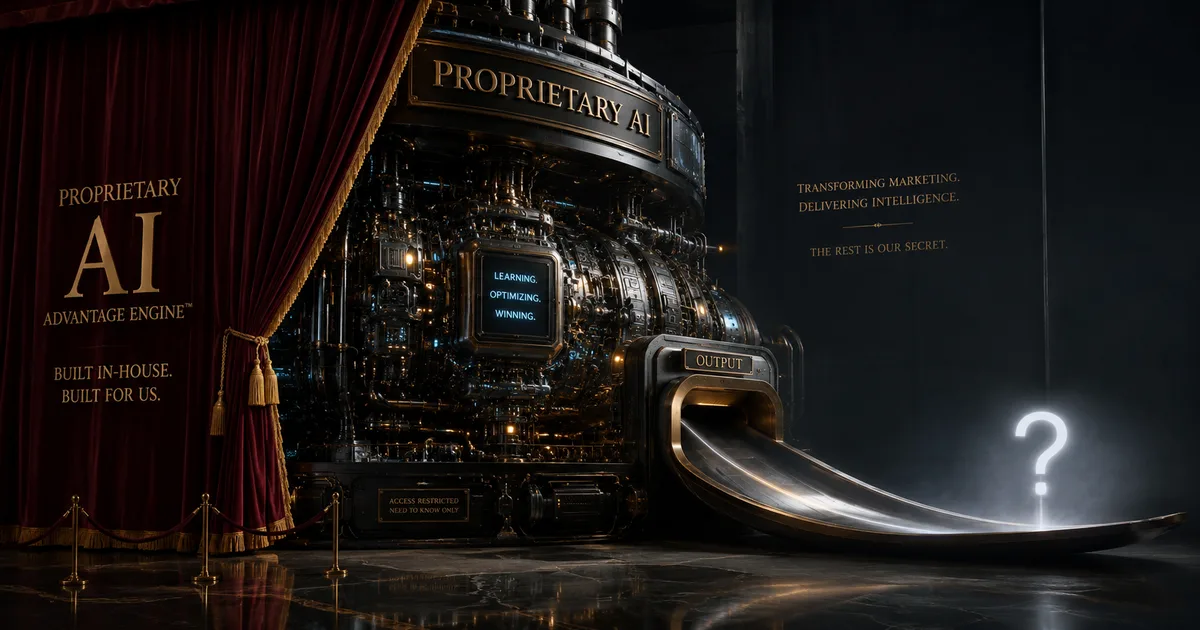
The agency holding companies that manage the world’s largest advertising budgets have quietly spent hundreds of millions building proprietary AI platforms. Whether those platforms are delivering value to the clients paying for them is a question the holding companies would rather you didn’t ask.
Key Takeaways
- The world's largest agency holding companies built proprietary AI platforms costing hundreds of millions, and your agency probably runs on one.
- WPP invested £300M in AI technology in 2025, claimed 90% employee adoption, and saw revenue fall 8.1% in the same period.
- Agencies inside these holdcos report being monitored for platform usage, which tells you adoption isn't organic.
- Publicis outperformed every holdco by embedding AI into operations rather than building a showcase platform.
Your Agency Built an AI Platform. You Probably Didn’t Know.
If your agency is part of WPP, Omnicom, Publicis, or Dentsu, the holding company above it has spent the last two to three years building a proprietary AI platform. WPP calls theirs WPP Open. Omnicom built Omni. Publicis invested in CoreAI. These aren’t side projects. WPP alone put £300M into AI-driven technology in 2025 (1. WPP, 2026).
The pitch behind these platforms: every agency in the holding company network uses the same AI-powered system for media planning, creative development, audience modeling, and campaign optimization. Client data stays secure inside the walled garden. The holding company controls the technology. Agencies get capabilities they couldn’t build alone. Clients get better work, faster.
That’s the promise. The question worth asking is whether your agency’s holding company is delivering on it, or whether the platform has become something else entirely: an asset that serves the holding company’s investor narrative more than your marketing outcomes.
How the Adoption Numbers Actually Read
WPP reported that 70,000 people used WPP Open monthly by December 2025, roughly 90% of client-facing staff, double the 33,000 who used it a year earlier (1. WPP, 2026). Those are real numbers from a public filing. They look like a platform that’s working.
Then comes the next sentence in the same filing: “increasing everyday usage across all our agencies is our key priority.”
Monthly active users is the number WPP reports to investors. Everyday usage is the number they still need from the people doing your work. The company’s own language separates the two. Agencies inside holdcos have described management messages flagging low usage and pressing teams to increase it. When the organization has to monitor whether employees use a tool it spent hundreds of millions building, the platform may work fine as a product. The question is whether the investment thesis behind it holds up.
WPP’s 2025 revenue fell 8.1% to £13.55 billion. Client losses and macro headwinds drove part of the decline, but WPP Open was positioned as the competitive edge that would offset those pressures (1. WPP, 2026). CEO Cindy Rose, hired from Microsoft’s Global Enterprise operation, attributed the underperformance to “excessive organisational complexity, a lack of an integrated operating model and inconsistent strategic execution” (1. WPP, 2026). Those are the problems the platform was supposed to fix. Three years in, WPP brought in a tech-sector executive to restructure the organization around it.
The Holding Company That Took a Different Path
Publicis Groupe grew 5.6% organically in 2025, projecting 4-5% for 2026, its seventh consecutive year of outperforming the sector (2. Publicis Groupe, 2026). Publicis took a different approach to AI: embed it into existing operations and client workflows rather than building a separate showcase product. The growth gap has multiple drivers. The AI platform isn’t obviously one of them.
Omnicom’s CEO John Wren told analysts that the financial impact of AI is “a book yet to be written.” Gains so far are “largely internal,” and enterprise clients move slowly (3. Digiday, 2025). Wren recalled an AI-generated ad featuring a cat in a hat that was rejected by a client’s legal team. The technology worked exactly as designed. The client’s approval process killed the output before anyone saw it.
Gartner projects that 50% of proprietary agency AI offerings will be obsolete by 2029 (4. The Drum, 2026). That projection carries more weight when the holdco investing most visibly in its platform is simultaneously restructuring around it.
What to Ask in Your Next Agency Review
Most clients never see their agency’s AI platform. They see the pitch deck. They hear “AI-powered” in the capabilities presentation. They don’t see whether the people doing their work actually use the platform, whether the platform changed how their campaigns run, or whether the holding company’s AI investment translated into better outcomes for their business.
Three questions cut through that:
Is your team choosing this platform or being told to use it? If the agency’s people adopt the platform because it makes their work better, that tells you something. If they’re being tracked on usage metrics and pressured by management, the platform is serving the holding company’s narrative, not your workflow.
Can you show me client outcomes the platform produced? WPP Open’s marketing claims 12% more new customers, 28% higher revenue, and 60% lower cost per acquisition. Those are vendor-reported numbers . Ask for results tied to your account, verified by someone other than the agency. Platform claims that live only in the agency’s deck haven’t been tested.
Is the platform the product or the pitch? These platforms started as tools to improve agency output. For some holding companies, they’ve become the thing being marketed to investors and clients. When analysts have to push holdcos to prove their platforms deliver differentiated results, the platform may be serving positioning more than performance.
AI is reshaping how agencies work and how clients buy marketing services. The question for you is whether a proprietary platform your holding company built on top of someone else’s models is delivering value to your business, or whether that investment would land harder in the operations, talent, and workflows that make any tool useful.
Frequently Asked Questions
Are agency holding companies' AI platforms working?
What is WPP Open and how effective is it?
How should CMOs evaluate agency AI platform claims?
Why is Publicis outperforming WPP and Omnicom?
References
- WPP PLC. (2026). Strategy Update and 2025 Preliminary Results. https://markets.ft.com/data/announce/detail?dockey=1323-17477290-1Q8TEVR2NNFQVT91FOUCPOQ2BF
- Publicis Groupe. (2026). Full Year 2025 Results. https://www.publicisgroupe.com/en/news/press-releases/publicis-groupe-2025-full-year-results
- Joseph, S. (2025). AI is reshaping Omnicom’s workflow. Its revenue model may be next. Digiday. https://digiday.com/marketing/ai-is-reshaping-omnicoms-workflow-its-revenue-model-may-be-next
- The Drum. (2026). Agency landscape more unstable than ever: Can holdcos land centralizing pivots. https://www.thedrum.com/news/agency-landscape-more-unstable-than-ever-can-hold-cos-land-centralizing-pivots