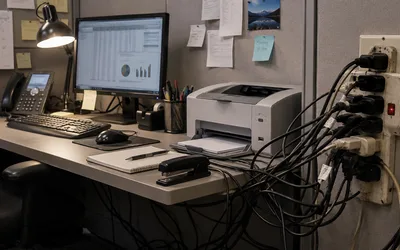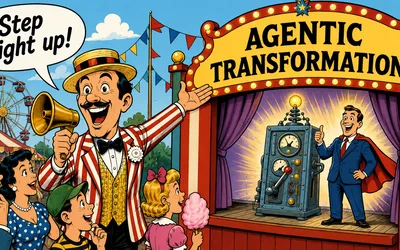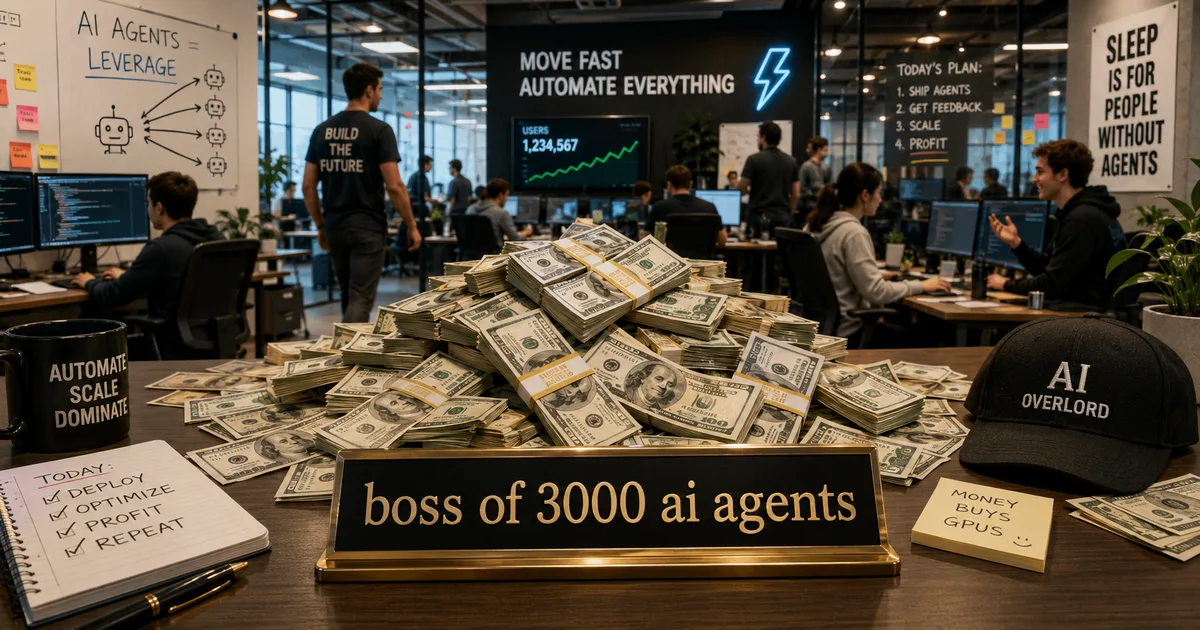
A one-person marketing department runs on one assumption: that one human can check everything a fleet of AI agents cranks out. The more the agents produce, the faster that assumption falls apart.
Key Takeaways
- A one-person marketing department can generate content all day, but the limit is how much one human can review well.
- The more content your agents produce, the deeper the pile of work waiting for a human to check.
- A reviewer who also builds the system is a single point of failure, not a scaled marketing team.
- Reality check: the win comes from sorting work by what's at stake, staffing the checking, then rejecting most of what AI drafts.
ClickUp is hiring one person to run all of its marketing. Not a team lead, not a department head with people underneath. One human, paid up to $1 million, pointed at a fleet of roughly 3,000 AI agents where a marketing department used to be (1. State of Brand, 2026).
The internet read that number as a verdict on taste. If agents can execute, the thinking goes, then the only scarce thing left is the human judgment that decides what’s good. Pay one person a fortune for that judgment and let the machines do the rest.
Whether that posting is a real hire or a publicity stunt doesn’t much matter. The economics it points at are real, and the popular reading gets them backwards. Put one person in charge of all the marketing , and the thing that runs out first is time to check the work. AI made producing content cheap. It did nothing for the hours a human still needs to read that content, catch what’s wrong, and decide what’s good enough to ship.
Cheap to make, expensive to check
When you can generate a week’s worth of content before lunch, producing the work stops being the hard part. Checking it becomes the hard part. Every draft an agent produces still needs a human to confirm it’s accurate, on-brand, and not quietly promising a feature your product doesn’t have or citing a competitor’s data as your own.
Frank Days, who runs marketing for a technology company and writes the Vibecoding CMO newsletter, put real numbers on it. In one month he spent about four hours generating content with an AI agent and sixteen hours reviewing it (2. Days, 2025). Four hours checking for every one spent making. He rejects a large share of the drafts outright and publishes only a portion of what the agent writes. That’s one operator’s month, not a study. But the shape matches what’s happening a whole industry over.
His line for it: “Less time writing, more time judging. Less execution, more curation” (2. Days, 2025). The work moved downstream, to the seat where someone decides what’s good enough to ship.
Review doesn’t scale the way generation does
Here’s the part the million-dollar math skips. Making the stuff gets easier the more agents you add. Point more of them at the work and you get more, faster. Checking it goes the opposite way. Sorting fifty drafts down to the two worth keeping is quick. Sorting five thousand is a different job, and it gets bigger every time you speed up the making (1. State of Brand, 2026).
Software engineering ran this experiment a year ahead of marketing, at real scale. Teams that put AI coding assistants to work watched output climb faster than anyone could review it, until the reviewers were the thing holding everything up. They gave it a name, the inspection bottleneck: code review “cannot scale linearly with AI output” (3. Agility at Scale, 2026). Same shape, different department.
The uncomfortable part: the faster your agents work, the bigger the pile of stuff waiting to be checked. Speed up one side and you clog the other.
One reviewer is a single point of failure
ClickUp’s design puts the writer, the editor, and the standards body in the same chair. One person builds the system, then grades what it produces. That sounds efficient until you notice there’s no independent check anywhere in it .
As State of Brand put it, “a reviewer with nobody reviewing them is just someone with preferences” (1. State of Brand, 2026). Every check in the company now runs through a single person who occasionally takes a week off. Run all of it through one human and every check piles onto one desk, with the risk stacked right there too. One person becomes the whole quality operation, and the single point where it breaks.
Compare that to how Anthropic structured a similar bet: an outside editor checking writing the company was already publishing. The person doing the checking sits apart from the person doing the work. That separation is what turns one person’s taste into a check the rest of the company can trust.
The part that never sped up
Solve the volume problem and you still haven’t freed the person. Some of marketing was never about volume in the first place. Positioning a product. Deciding what not to ship. Handling a crisis. Building the relationships that decide whether any of the work even gets seen. None of that goes faster with more agents, and all of it lands on the same overloaded person.
So the pile of stuff to check does more than slow down what you publish. It eats the hours that should go to the big-picture work, the exact thinking you hired someone with taste to do. The checking crowds out the very work the whole setup was meant to protect.
What this means for your stack
ClickUp’s posting raises one question worth sitting with: can you describe your review loop out loud? When a draft gets rejected in your shop, does anything downstream change, or do you just get a revised version and move on?
The teams getting real value out of running marketing on AI agents are the ones who rebuilt the process around review. They sort work by what’s at stake, build real checks for each kind, and staff the seat that says no. Days figured this out the hard way and started splitting his content into high-stakes and low-stakes piles so his own hours went where they mattered (2. Days, 2025).
Before you copy the one-person model, answer one thing. How many drafts a week can your best reviewer reject well? That number, not your agent count, is what you can really handle.
Frequently Asked Questions
Can one person run a marketing department with AI?
What is the real bottleneck in AI content production?
Why doesn't review scale like AI generation?
How do you fix an AI content review bottleneck?
Is the one-person marketing department a good model?
References
- State of Brand. (2026). The 100x CMO job is here. ClickUp is paying up to $1M for one person to be the entire marketing department. https://www.thestateofbrand.com/news/clickup-100x-cmo-one-person-marketing
- Days, F. (2025). The AI content bottleneck no one warned you about. The Vibecoding CMO. https://vibecodingcmo.substack.com/p/the-ai-content-bottleneck-no-one
- Agility at Scale. (2026). SAFe built-in quality when AI agents write the code. https://agility-at-scale.com/safe/ai-enabled-safe/safe-built-in-quality-when-ai-agents-write-the-code