Bloated license fees, stack sprawl, and training gaps aren’t three budget problems. They’re one cycle, each feeding the other two, and fixing them separately is why the fixes never stick. The remediation requires treating all three as a single system and building organizational capability before buying anything else.
Key Takeaways
- License waste, stack sprawl, and training gaps form one reinforcing cycle. Addressing any one without the others redistributes the problem.
- The average enterprise wastes $19.8 million annually on unused SaaS, then buys more tools to fill gaps the existing stack already covers.
- Training budgets at 3.8% of marketing spend can't keep pace with stack growth. Benchmark: 15-20% of license cost for enablement.
- Coordinated remediation starts with a capability assessment, not a vendor evaluation. Diagnose what your team can operate before deciding what to buy.
- The cross-functional audit will surface political resistance. Whoever approved the redundant tools and cut training is still in the room.
The Cycle Nobody Names
Ask an enterprise marketing leader what’s wrong with their martech stack and you’ll get three answers, usually delivered in the same breath: we’re overpaying for features nobody uses, we have too many tools that don’t talk to each other, and the team can’t keep up. PwC’s 2026 Digital Trends in Operations Survey confirms the pattern at enterprise scale: 89% of 767 operations leaders say their technology investments haven’t fully delivered expected results (1. PwC, 2026).
What should concern them is how consistently they treat these as three separate problems with three separate fixes. License costs go to procurement for renegotiation. Stack rationalization becomes an IT-led consolidation project. Training gets a line item that disappears in Q3 budget cuts.
Three projects. Three sponsors. Three timelines. None of them talking to each other.
They keep failing because bloated licenses, stack sprawl , and training gaps aren’t three problems. They’re one cycle. Every new license increases the operational burden on an already-stretched team. Stretched teams can’t learn the tools they already have, so gaps appear in campaign execution. Gaps get filled with point solutions purchased outside governance. The stack grows. The team falls further behind. The next renewal arrives, the vendor raises prices, and leadership demands consolidation. The consolidation project buys a bigger platform to replace three smaller ones. Nobody budgets training for the new platform. The cycle restarts.
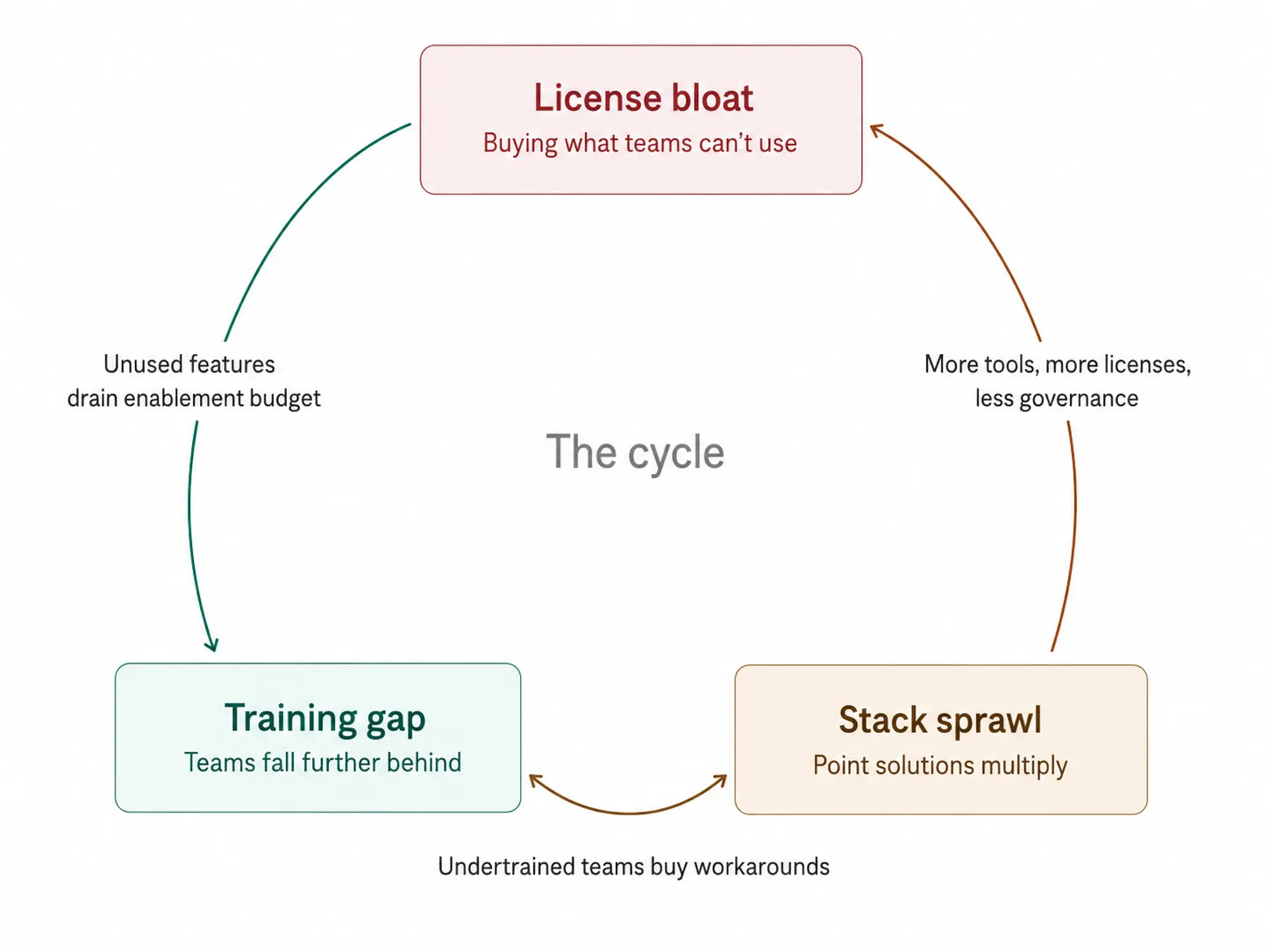
The martech inefficiency cycle: three problems reinforcing each other.
Platforms amplify what your team can already do. They don’t create capability through deployment . When you skip the diagnostic work of understanding your own operational readiness and jump straight to procurement, you buy technology that exceeds what your teams can activate.
Breaking the cycle requires treating all three problems as one system. That’s what this white paper gives you: the diagnosis, the framework, and the Monday-morning playbook to break it.
License Bloat: Buying What Your Team Can’t Operate
Every vendor demo tells the same story. Fifteen capabilities. Your team needs six. The per-feature cost looks marginal, the roadmap slides look impressive, and “we’ll grow into it” feels like a reasonable bet. Procurement evaluates on feature coverage because that’s what the RFP was built to measure. Nobody asks whether your team can operationalize what you’re about to sign for.
Twelve months later, your team uses four of the six capabilities they needed. The two they couldn’t activate? Configuration requirements that nobody scoped. Behavioral scoring that assumes data quality your CDP doesn’t provide. Dynamic content personalization that requires a content operations velocity your team can’t sustain. The eleven speculative features sit untouched.
The Zylo 2026 SaaS Management Index quantifies what that pattern produces at scale. Across 40 million licenses and $40 billion in tracked spend, the average enterprise wastes $19.8 million annually on SaaS that isn’t fully activated (2. Zylo, 2026). That’s not a rounding error. It’s a structural failure in how organizations buy technology.
Platforms amplify what your team can already do. They don't create capability through deployment.
The failure isn’t procurement’s. It sits upstream, in the absence of a capability assessment before the buying decision. Before evaluating which platform to buy, you need to answer what the technology must accomplish and whether your team can activate it. When that alignment doesn’t exist, any technology investment can claim strategic fit because the criteria to evaluate fit were never specific enough to distinguish one platform from another.
Here’s what capability-scoped procurement looks like in practice. Before signing any license, three questions need answers:
Can your team operationalize the core capabilities within 90 days of deployment? Not “can we train them eventually.” Can the team, with its current skills and bandwidth, configure and activate the features you’re buying within a quarter? If the answer requires hiring, restructuring, or a multi-month enablement program, the total cost isn’t the license fee. It’s the license fee plus the capability build. Both go into the business case or the business case is fiction.
Have you tested the capabilities you’re buying against your actual data, content, and process constraints? The demo runs on clean data, unlimited content, and zero approval workflows. Your environment has duplicate records, a content team producing four assets a month, and a six-step review cycle.
Is the training and enablement plan funded as part of the contract, not as a discretionary budget? If enablement depends on a line item that can be cut in Q3, it will be cut in Q3. The benchmark is 15-20% of license cost allocated specifically to training and enablement (3. De Libero, 2026). If you can’t fund that, you can’t afford the license.
Stack Sprawl: Filling Gaps That Training Would Close
Stack sprawl doesn’t happen because people make bad purchasing decisions. It happens because buying a new tool is faster than figuring out whether the existing stack already covers the gap.
The marketing automation platform can’t produce the segmentation your campaign team needs. Or so they think. Nobody asks whether the platform actually supports it and the team hasn’t been trained to configure it. Instead, someone buys a point solution. That point solution needs data the CDP already has but can’t export in the format the new tool requires. So someone builds a workaround, or buys an integration layer. And now a capability gap that training would have closed has become a $45,000 annual license plus $15,000 in integration maintenance.
Multiply that across a few dozen teams, and you get the Zylo finding: 45% of SaaS spend now happens outside IT governance entirely (2. Zylo, 2026). It isn’t shadow IT in the malicious sense. It’s practitioners solving problems faster than the organization can support them. Every purchase is rational in isolation. The cumulative effect is irrational.
The downstream cost shows up in integration complexity. The MarTech State of Your Stack survey puts data integration at the top of the challenge list: 65.7% of respondents cite it as their primary obstacle, with 45% pointing to a lack of skilled resources as a significant barrier (4. Chiefmartec/MartechTribe, 2025). But integration complexity is a second-order problem. The first-order problem is that every tool added to the stack creates integration work that competes with the training time needed to use existing tools.
Six operational areas determine where capability breaks down: people, processes, data, content, automation, and measurement. These don’t operate independently. People capability gaps prevent process execution. Process constraints ruin data practices. Data failures break automation reliability. Every tool added to the stack without a corresponding capability assessment adds burden across all six areas simultaneously.
The concept that matters here is the binding constraint. When you fix one capability area, you don’t fix the system. You surface the next constraint. Build the behavioral segmentation skills your team lacks, and your processes immediately expose bottlenecks those skills were never fast enough to hit. Fix the data practices, and your automation suddenly has reliable triggers that reveal your content operations can’t keep pace with the required velocity. Every improvement shifts the constraint somewhere else. What looks like failure is the system starting to function.
The fix starts with a decision rule: before any new tool purchase, run a capability-gap analysis. Can the gap be closed through training and configuration on an existing platform? If yes, training wins. No exceptions. If a new tool is genuinely needed because the platform ceiling has been confirmed through systematic testing, the purchase approval includes a training plan, an integration impact assessment, and a named owner for ongoing operational support. Miss any of those three and you’re feeding the cycle.
The Training Gap: The Investment Nobody Makes
Training budgets are the first thing cut and the last thing funded. CMO Survey data tells you exactly what that produces: marketing technology training budgets sitting at 3.8% of total marketing spend, and no single martech capability scoring above 5 out of 7 on self-assessed proficiency, even after two years of heavy AI investment (5. CMO Survey, 2026). Teams have been given increasingly sophisticated platforms and decreasing support to learn them.
The math gets worse when you factor in headcount. Marketing teams have contracted by roughly half since the pre-pandemic peak. Fewer people. More tools. Less training.
At the C-suite level, the consequences are already visible: 65% of CEOs don’t trust their CMOs, and only 28% of marketers believe their teams are fully trained to use their stack effectively (6. Galloway & Yarkosky, 2025). Most teams can follow workflows, but few know how to use tools to think strategically, connect data to revenue, and shape smarter decisions. Organizations have outsourced their thinking, first to vendors, and now to AI tools, without building the institutional muscle to evaluate what either one delivers.
People capability is where the constraint most often originates. Organizations track training completion without checking whether teams can apply those concepts in production. Vendor training teaches platform features. Nobody learns how to design behavioral logic, build scoring models that predict closed-won deals, or connect orchestration triggers to business outcomes.
A financial services firm invests in replacing its marketing automation platform because it allegedly lacks behavioral scoring. Assessment reveals the platform already has sophisticated scoring features, but nobody has ever configured them. The constraint is a skills deficit. The platform already has the features. The team can’t build scoring models or integrate them into campaigns. No platform replacement addresses that constraint. It travels with the organization.
The training benchmark provides the specific numbers: 15-20% of each platform’s license cost allocated to training and enablement, with 1 FTE dedicated per 3-4 core platforms for ongoing operational support (3. De Libero, 2026). Most organizations aren’t spending a quarter of that. They’re buying $200,000 platforms and allocating $3,000 for a two-day onboarding workshop, then wondering why the team plateaus at month three.
Undertrained teams can’t use what they have. Underused tools look like bad investments. Leadership demands consolidation or replacement. The replacement arrives with a vendor demo and an implementation timeline. Nobody budgets training for the new platform because nobody budgeted training for the old one. Every tool swap without a training plan is a bet that the next platform will be intuitive enough that your team won’t need help. That bet has never paid off.
The fix requires making enablement non-negotiable. Build the training line item into every license agreement. Not as discretionary spend that gets cut when revenue misses. As a contractual commitment that’s part of the total cost of ownership. And “training” means capability building, not vendor-led feature walkthroughs. Your team needs to learn how to connect platform capabilities to business outcomes in their specific operational context.
How the Cycle Completes, and Why Separate Fixes Fail
Trace it at the operational level. Marketing leadership signs a platform contract based on a feature evaluation. Nobody scoped to the team’s operational capacity, so features that looked compelling in the demo sit unconfigured. Three months in, campaign execution reveals gaps that look like platform limitations but are actually training gaps. Nobody runs the diagnostic to distinguish one from the other. Someone buys a point solution to fill the gap. The integration work lands on an already-stretched team. Data starts flowing through undocumented pathways. Governance erodes. The next vendor renewal arrives with a price increase.
Three separate remediation projects attack this from three angles. Procurement renegotiates licenses. IT leads stack rationalization. HR gets a budget for technology training. Each project succeeds on its own metrics. License costs go down for one renewal cycle, tool count shrinks temporarily, training completion rates go up.
Eighteen months later, the same cycle runs at the same velocity. The license renegotiation didn’t address the capability gaps that drive underuse. The stack rationalization consolidated tools without investing in the training required to use the surviving platforms fully. The training program taught features on platforms that are about to be rationalized. Three projects, three partial wins, zero systemic change.
The discipline that breaks the pattern is sequential: assess capability first, optimize what you already own second, and only then decide whether new technology is needed. These principles come from the Marketing Technology Transformation® methodology, but the logic is self-evident. You wouldn’t buy a second oven because the first one only makes toast if you’ve never checked whether the first one has a broiler setting.
Systematic optimization of your existing stack reveals where the ceiling is real and where it’s a capability gap masquerading as a platform limitation. Only when optimization evidence confirms that current platforms genuinely can’t deliver what strategy requires does new technology acquisition make sense. And by that point, you’ve built the operational maturity and governance that make new investments actually produce. Skip that step, and you bring immature operations into a new platform. Same constraints. More expensive technology.
Monday Morning: One Project, Not Three
Stop running three remediation tracks. License optimization, stack consolidation, and training enablement are one coordinated project or they’re three projects that each fail.
Days 1-30: Build the diagnostic foundation.
Pull license utilization data, platform capability coverage, and team proficiency self-assessments into the same room. Not three separate reports delivered to three separate owners. One cross-functional audit with MOps leading and the CMO sponsoring.
Map every platform against three questions: Is it licensed? Does it have the capability we need? Can our team operate it? The intersection of “licensed, capable, but not operated” is your first target. Those platforms represent waste that training can recover. The platforms where the capability doesn’t exist regardless of training are your rationalization candidates.
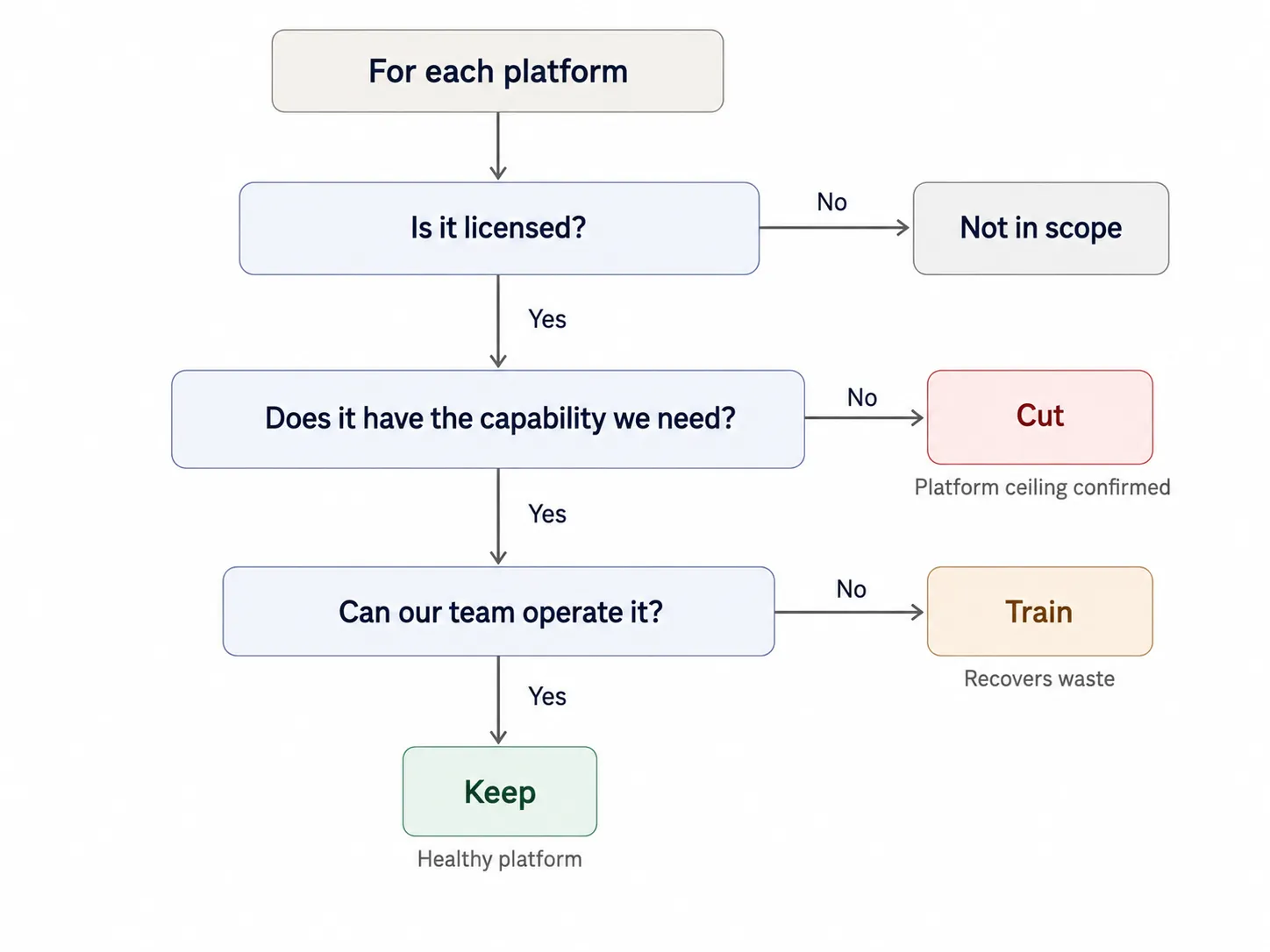
The three-question platform map: a decision framework for every tool in your stack.
The team running this audit needs operational credibility and organizational authority. MOps leaders know the reality but often lack the authority to challenge senior leadership’s past purchasing decisions. The combination of operational knowledge with executive mandate produces the most reliable assessment.
Days 31-60: Close the capability gaps on your highest-cost platforms first.
Rank your platforms by annual license cost. Start enablement at the top. Not vendor-led feature walkthroughs. Capability building: how to connect platform features to business outcomes in your specific operational context, with your actual data quality, your actual content velocity, your actual approval processes.
Measure capability gain at 60 days. Not training completion. Operational output. Can the team configure and activate features they couldn’t before? Are campaign execution timelines improving? Is the gap between platform capability and team proficiency narrowing?
Days 61-90: Cut with evidence, not assumptions.
The platforms where capability scores don’t move after proper enablement have a fit problem, not a skills problem. Cut those. You’ve now got evidence that the platform ceiling is real, not a proxy for undertrained teams.
For every surviving platform, document the ongoing enablement requirement: specific skills needed, training cadence, named owner for operational support. 1 FTE per 3-4 core platforms is the operating model. If you can’t staff that, you have more platforms than your organization can sustainably operate.
Going forward: Build the procurement gate.
No new platform purchase proceeds without a capability-scoped business case that includes: the team’s current proficiency on the relevant capability, the enablement plan and its cost, the integration impact assessment, and the total cost of ownership including training. If any of those four elements is missing, the purchase isn’t ready. You’re buying a feature list, not a capability.
The political dimension: plan for it.
The cross-functional audit will surface who approved the redundant tools, who cut the training budget, and who’s been buying point solutions outside governance. Those people are still in the room. The audit is a political exercise as much as a technical one.
Acknowledging the politics doesn’t make the audit adversarial. Executive sponsorship from the CMO prevents it from becoming a procurement exercise that optimizes cost without addressing the training and sprawl dimensions. Framing the audit as “building capability” rather than “assigning blame” creates space for honest participation. But don’t pretend the politics aren’t there. The organizations that succeed at this acknowledge the political dimension and plan their sequencing around it.
Frequently Asked Questions
How do I calculate the true cost of an underused martech platform?
Should I consolidate my stack before or after investing in training?
What percentage of marketing budget should go to martech training?
Who should own the cross-functional martech audit?
How do I prevent stack sprawl from recurring after consolidation?
What's the difference between a platform limitation and a training gap?
How long does it take to see results from coordinated remediation?
How do I get executive buy-in for training investment when the C-suite wants cost cuts?
References
- PwC. (2026). 2026 Digital Trends in Operations Survey. PwC US. https://www.pwc.com/us/en/services/consulting/supply-chain-operations/library/digital-trends-operations-survey.html
- Zylo. (2026). 2026 SaaS Management Index. Zylo. https://zylo.com/resources/saas-management-index/
- De Libero, G. (2026). The martech investment nobody budgets for. MarTech. https://martech.org/the-martech-investment-nobody-budgets-for/
- Chiefmartec/MartechTribe. (2025). The State of Your Stack Survey 2025. https://chiefmartec.com/state-of-your-stack/
- Moorman, C. (2026). The CMO Survey: 35th Edition. Duke Fuqua School of Business/Deloitte/AMA. https://cmosurvey.org
- Galloway, J. & Yarkosky, A. (2025). You’re Wasting Money on Your Martech. Alvarez & Marsal. https://www.alvarezandmarsal.com/sites/default/files/2025-11/You%E2%80%99re%20Wasting%20Money%20on%20Your%20Martech.%20Win%20Back%20C-Suite%20Trust%20by%20Taking%20Control%20of%20Your%20Stack..pdf