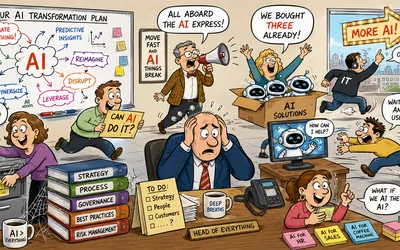
The evolution of the CMO has run in a loop. Since 2008, the role has circled one unsolved problem, proving marketing’s value, while analytics, then digital, then AI each arrived as the fix that would finally settle it. None did.
Key Takeaways
- The evolution of the CMO since 2008 is a loop around a single question: can marketing prove its value?
- Three technologies were each sold as the answer, analytics, then digital, then AI, and the survey's own data shows the provable-impact rating barely moved across all three.
- Reality check: AI won't break the loop on its own. The two prior waves raised expectations faster than provable return, and the earliest AI numbers already match that pattern.
- What changes the outcome is whether marketing and finance ever define what value means in terms the CFO will sign. The tool is beside the point.
The question marketing has never put to rest
The evolution of the CMO looks like a climb and behaves like a circle. More title power than the 2008 CMO held, bigger budgets, a seat closer to the board, a fluency in data that would have been science fiction two decades ago. Underneath all of it sits one question that marketing has been asked, in some form, every year since The CMO Survey began running in 2008: what is marketing worth to the business? Eighteen years and thirty-five editions later, the question is still open.
You can watch it stay open in the survey’s own numbers. In Spring 2026, the two most common ways marketing leaders say they show their worth to the rest of the company are building stronger performance tracking, named by 86.3%, and demonstrating financial impact, named by 75% (1. The CMO Survey, Spring 2026). Those are the habits of a function still making its case eighteen years in. The same edition finds most marketing leaders still feeling pressure from the CEO and the CFO to prove marketing’s value, and rates the CFO’s willingness to partner on a marketing business case at 4.5 on a 7-point scale, barely up from 4.3 four years earlier (1. The CMO Survey, Spring 2026). Four years of effort moved that relationship two-tenths of a point.
Raja Rajamannar, who ran marketing at Mastercard for more than a decade before moving to a senior fellow role in 2026, said the quiet part out loud back in 2018. Companies were eliminating the CMO job, he noted, because “CMOs in many companies are not able to justify their role. They’re not able to prove the value they bring to the table for the CEO, for the CFO” (2. Ad Age, 2018). Greg Stuart, who runs MMA Global and hosts the Building Better CMOs podcast, has built an entire show on a premise that should be embarrassing for a role this senior: nobody can quite agree what a CMO is even for.
Here’s what the industry keeps missing in its rush to name the next era. Every few years, a new technology arrives carrying the same promise: this time, finally, marketing will be able to answer the value question for good. Analytics carried it. Then digital. Then AI. Each was sold as the resolver. None resolved it. So the role circles. Eighteen years on, it has never closed on an answer.
False dawn one: analytics was going to make marketing provable
In the middle of the last decade, marketing analytics carried the entire weight of the value question. The pitch was hard to argue with. Instrument everything, attribute everything, and marketing finally speaks the language finance respects. The CMO Survey captured the optimism in a single number: in early 2018, marketing leaders forecast their analytics spend would grow 198% over the following three years (3. The CMO Survey, Spring 2018). That number is a belief dressed as a budget line: the answer was supposedly one more layer of measurement away.
The belief didn’t survive the data it generated. The survey asked, edition after edition, how much marketing analytics actually contributed to company performance, on a 1-to-7 scale. Across six years the rating crept from 3.7 to 4.1 (3. The CMO Survey, Spring 2018). Six years of rising spend, an entire profession of attribution modeling, and the needle on provable contribution moved four-tenths of a point and never reached the middle of the scale. The forecast drew a hockey stick. The result drew a flat line. And underneath even that modest number sat a quieter problem the survey kept surfacing: fewer than half of marketing decisions drew on the analytics being bought. The spend was real. The use lagged it, and the proof lagged the use.
What makes the analytics era worth studying is that even the operators who arguably won with it stayed trapped in the same argument. Rajamannar’s Mastercard is the canonical analytics-era success story. He put a finance officer inside the marketing department, tied campaigns to specific products and geographies, and by 2018 could say something almost no CMO could: “For the first time, our CFO has gone in front of the analysts saying he is increasing money in marketing. There’s a clear perception, based on reality, that marketing is driving business” (4. WFA, 2018). That’s the dream result. And in the same window, the broader survey shows the rest of the profession nowhere near it, and Rajamannar himself was warning the room about an existential threat to the role. The tool worked for the rare leader who already thought like a general manager. For the function as a whole, it raised the expectation of proof faster than most teams could produce it, which is a different outcome than the one on the brochure.
False dawn two: digital was going to close the gap
The pandemic did to digital what no strategy deck ever could. It made the transformation mandatory and instant. Budgets moved in weeks, channels collapsed into screens, and for a stretch marketing looked indispensable. By the Fall 2021 CMO Survey, digital marketing had climbed to 58% of all marketing budgets, and marketers had been handed the lead on their companies’ digital transformation at 73% of firms (5. The CMO Survey, Fall 2021). Marketing held the budget and the mandate both, trusted to run the change. If any wave was going to convert indispensability into settled credibility, this was it.
Then the same gap reopened under the spend. The Fall 2021 survey asked companies how far their digital transformation had matured. Only 11.4% had reached the stage where they could use digital investments to drive and evaluate marketing decisions (5. The CMO Survey, Fall 2021). The money went in at scale. The decision-grade capability mostly didn’t arrive. Worse, by 2026 several of the survey’s digital-readiness measures had slipped back below their pandemic-era highs. The share of teams reporting they had the skills to use their marketing systems fell from 54% to under 50% even as the tools multiplied (1. The CMO Survey, Spring 2026). The surge bought activity and reach. The settled proof of value stayed out of reach.
Rajamannar’s pandemic pivot shows the same shape in miniature. In April 2020 he reframed Mastercard’s whole posture in one line: “There are times when you want to sell. This is not a time when you want to sell. This is the time to serve” (6. Digiday, 2020). Fast, fluent, digital. Three years later, at Cannes Lions in 2023, he walked onstage with Mastercard’s CFO for a session on the marketing-finance relationship, reportedly the first time a sitting CFO had ever spoken at the festival. The figure he brought should have stung a profession a decade into the analytics-and-digital project: “It’s shocking that less than 40% of the finance people think that marketers can make sound commercial decisions” (7. BestMediaInfo, 2023). He didn’t spare his own side either. Marketers, he said, “often don’t connect” their actions to business outcomes “because many a times we don’t even care to measure” (7. BestMediaInfo, 2023). Two technology waves in, with a far more digital marketing organization than 2008 ever imagined, the trust gap was still the headline act.
False dawn three: AI is going to finally prove it
Now it’s AI’s turn to carry the promise, and the promise is word-for-word the same. The Spring 2026 CMO Survey reports that companies expect AI to account for 55.9% of all marketing activities within three years (1. The CMO Survey, Spring 2026). Set that beside the analytics forecast from 2018, the 198% in three years, and the resemblance is the loop showing its hand. Every wave arrives with a steep three-year projection and the same underlying claim: adopt this, and the value question finally closes.
The difference this time is that the early numbers are already visible, and they rhyme with everything that came before. AI use in marketing more than tripled between 2024 and 2026 (1. The CMO Survey, Spring 2026). Over the exact same stretch, the survey’s read on how well companies perform on marketing-technology activities didn’t improve at all. Not one marketing-technology activity scores above 5 on the 7-point performance scale, and the two that sit at the center of the value question barely moved: generating return from marketing technology held flat at 4.5, and demonstrating that return inched from 4.2 to 4.4 (1. The CMO Survey, Spring 2026). Adoption tripled. Provable value stalled. That is the analytics curve from a decade ago, redrawn with a newer, shinier label.
None of this means AI will fail. It hasn’t fully played out, and the forecast could still land where the optimists say. The honest claim is narrower and harder to wave away: AI is being sold with the precise promise that analytics and digital each made and neither kept, and the earliest evidence already carries the same fingerprint, expectations climbing faster than provable return. And the survey’s own explanation for why has nothing to do with the technology. The barriers companies name are organizational, lack of budget, weak integration and data architecture, no bandwidth, thin talent. Investment in the tools keeps outrunning investment in the capability to use them. That sentence has been true for three waves in a row, which is the strongest evidence we have that the tool was never the variable that mattered.
Outside the survey, the picture matches. An independent 2026 study of 100 B2B marketing leaders found AI delivering real return for the 23% who built genuine workflows around it, while 53% were, in the researchers’ words, still “buying licenses and calling it a strategy” (8. Wynter, 2026). The technology worked. The organization around it mostly didn’t, which is the analytics story and the digital story wearing a third costume. It helps to be precise about where AI belongs here. Vasant Dhar, the NYU professor whose 2025 book Thinking with Machines maps where machines earn trust, sorts decisions by the cost of getting them wrong: hand the machine the cheap mistakes, keep humans on the expensive ones (9. Dhar, 2025; 10. Dhar, 2016). Drafting a campaign is a cheap mistake. Convincing a CFO that marketing earned its budget is not. AI is already strong at the first and structurally absent from the second, and the value question has only ever turned on the second.
Why the CMO role keeps splitting
If the value question stayed politely unanswered, the loop might be harmless. It isn’t, because the business doesn’t wait politely. When marketing can’t prove its worth in the terms the C-suite uses, the C-suite stops waiting and reshapes the role. Rajamannar watched it happen in real time in 2018, as companies swapped CMOs for chief revenue and chief growth officers. Large companies, he said, “are saying, ‘we are spending hundreds of millions of dollars on marketing, what am I getting in return?’”, and when the answer comes back in the language of awareness and impressions instead of revenue and margin, “some companies are losing patience and replacing CMOs with a chief revenue or chief growth officer” (11. Marketing Week, 2018). The new titles are leadership routing around a function it can’t read .
The cruelty of the loop is that the role keeps growing while the proof keeps not arriving. The 2026 survey shows marketing’s formal scope widening across nearly every activity it touches, with its claim on revenue growth, public relations, and customer insight all climbing year over year (1. The CMO Survey, Spring 2026). Each new responsibility lands on the same unproven foundation. A bigger remit resting on an unanswered value question is exposure dressed as advancement, which is why the expanding CMO role and the disappearing CMO role are the same story told from two ends.
The pressure does more than rename the role. It bends how marketing works. Faced with the demand to prove value, 70.6% of marketing leaders in the Spring 2026 survey respond by tilting toward short-term impact over long-run gains (1. The CMO Survey, Spring 2026). That tilt is the loop tightening on itself. The unanswered question pushes marketers toward whatever is easiest to show this quarter, which is rarely what builds the most durable value, which keeps the durable value invisible, which keeps the question open for the next cycle. Each turn of the wheel makes the next turn more likely.
By 2026, out of the operating seat and looking back across the whole arc, Rajamannar’s own diagnosis lands somewhere other than the tools. The reason marketing keeps losing influence, he said, is “because they did not understand the business dynamics. They did not put any effort to learn the business completely in a way that the CFO and CEO understand.” His blunt read on where that left the profession: a study found “an overwhelming 80% plus majority of CEOs say that they have zero confidence in their CMOs and in their marketing teams to drive sustained profitable growth” (12. Overline Consulting, 2026). After analytics, after digital, after stepping into AI, the man who rode all three traced the failure past every one of them, to a failure to define and defend value in business terms. The technology was never the thing standing in the way.
What actually breaks the loop
If three technologies in a row couldn’t close the value question, a fourth won’t either. What breaks the loop is a contract, the one document this whole history never produced. Marketing and finance have never agreed, in writing, on what value means in terms both will sign and how both will keep score. Without that, every campaign, every budget cycle, every new platform reopens the same negotiation from zero, and the newest technology becomes the newest place to have the oldest argument.
The single move in this entire history that genuinely shifted a CFO’s posture was structural. When Mastercard put a finance person inside marketing to prepare and present the return numbers, those numbers carried a credibility that marketing-authored reports never had (7. BestMediaInfo, 2023). The lesson runs deeper than “go hire a marketing CFO.” The value problem was always organizational, a question of who defines the terms and who’s trusted to keep the score, and it was solvable by organizational means a decade ago, with or without the era’s signature technology. The teams that treat each new wave as the answer keep skipping the work that actually moved the number.
None of this is free, and that’s exactly why it keeps not happening. Defining value in the CFO’s terms means giving up the soft metrics that make marketing look good in a bad quarter. It means measuring things that might show marketing underperforming. It means a CMO learning enough finance to be uncomfortable, and a CFO learning enough about brand to be patient with returns that don’t clear in ninety days. The loop has lasted eighteen years because the answer costs both sides something they’d rather not pay. The answer itself was never the unknown part.
So before the next platform demo, before the AI budget gets waved through on the promise that this is the one that finally makes marketing legible, the question worth carrying into the room is narrower and more uncomfortable than which tool to buy: have marketing and finance ever written down, together, what marketing is supposed to be worth and how both of us will know whether it is? If the answer is no, the pattern is already set. The technology will arrive, the expectation will rise, the proof will lag, and the role will circle the same hole one more time. The loop breaks the first time both sides agree on what they’re measuring and why. Better tools have never been enough.
Frequently Asked Questions
Isn't AI genuinely different from analytics and digital?
Does short CMO tenure cause the loop, or result from it?
Is the shift to chief growth and revenue officers real or cosmetic?
If the loop is real, what actually breaks it?
References
- Moorman, C. (2026). The CMO Survey: Highlights and insights report, Spring 2026. Duke University Fuqua School of Business, Deloitte, and the American Marketing Association. https://cmosurvey.org
- Braiker, B. (2018, June 7). Mastercard’s Raja Rajamannar: ‘Existential threat’ to CMOs. Ad Age. https://adage.com/article/podcasts/mastercard-marketer-existential-threat-faces-cmos/313766/
- Moorman, C. (2018). The CMO Survey: Highlights and insights report, February 2018. Duke University Fuqua School of Business, Deloitte, and the American Marketing Association. https://cmosurvey.org
- World Federation of Advertisers. (2018, January 23). Priceless success: Mastercard’s Raja Rajamannar. https://wfanet.org/knowledge/item/2018/01/23/Priceless-success-Mastercards-Raja-Rajamannar
- Moorman, C. (2021). The CMO Survey: Highlights and insights report, August 2021. Duke University Fuqua School of Business, Deloitte, and the American Marketing Association. https://cmosurvey.org
- Monllos, K. (2020, April 28). ‘This is not a time when you want to sell’: Mastercard CMO Raja Rajamannar on retooling advertising during a crisis. Digiday. https://digiday.com/marketing/this-is-not-a-time-when-you-want-to-sell-mastercard-cmo-raja-rajamannar-on-retooling-advertising-during-a-crisis/
- BestMediaInfo Bureau. (2023, June 20). How can CMOs and CFOs better their partnership to establish trust and transparency? BestMediaInfo. https://bestmediainfo.com/2023/06/how-can-cmos-and-cfos-better-their-partnership-to-establish-trust-and-transparency
- Wynter. (2026, May). How B2B marketing actually uses AI. Wynter Research. https://wynter.com
- Dhar, V. (2025). Thinking with machines: The brave new world of AI. Wiley.
- Dhar, V. (2016, May 17). When to trust robots with decisions, and when not to. Harvard Business Review. https://hbr.org/2016/05/when-to-trust-robots-with-decisions-and-when-not-to
- Vizard, S. (2018, July 30). Mastercard on the ’existential crisis’ facing CMOs and how it can be fixed. Marketing Week. https://www.marketingweek.com/mastercard-existential-crisis-cmos/
- King, N. (Host). (2026, March 30). The renaissance of marketing in the age of AI with Raja Rajamannar, Mastercard [Audio podcast episode]. Time for a Reset. Overline Consulting. https://overlineconsulting.com/insight/the-renaissance-of-marketing-in-the-age-of-ai-with-raja-rajamannar-mastercard/