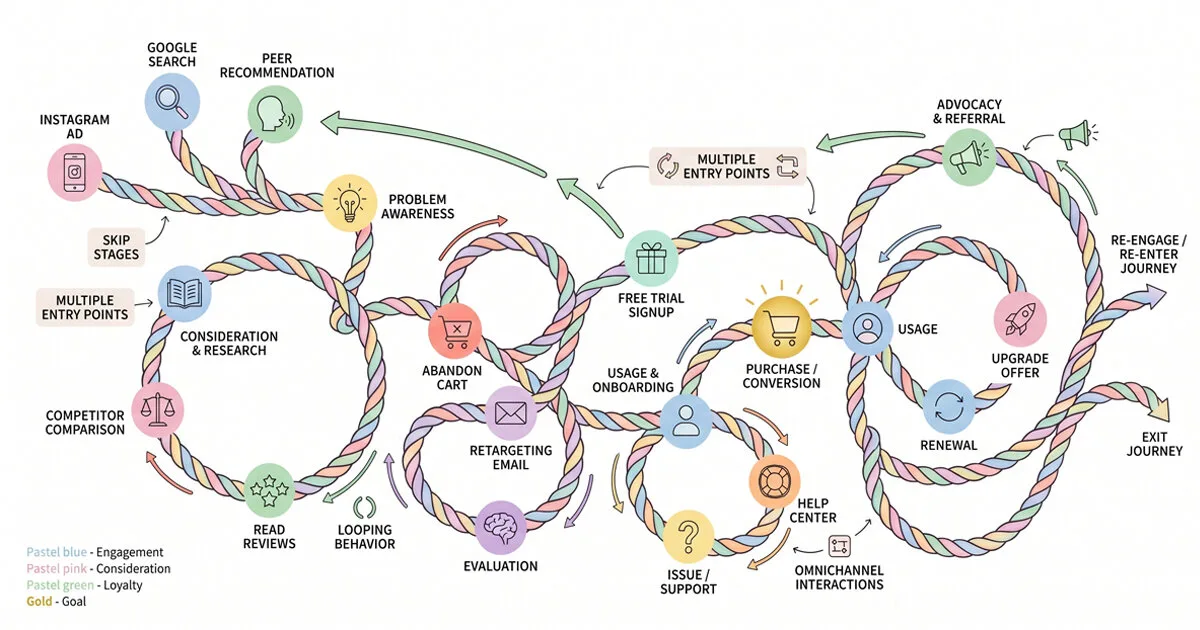
Most martech stacks are configured for buyer behavior that disappeared years ago: linear journeys, early sales conversations, and vendor-led evaluations. Reconfiguring around how buyers actually research and decide delivers more value than adding new tools.
Key Takeaways
- Winning vendors make the shortlist before first contact 95% of the time. Configuration determines whether you're on it (1. 6sense, 2025).
- Lead scoring rewards engagement volume over evaluation depth, hiding real buying signals.
- Most CRMs track buying committee members as isolated leads, fragmenting group intelligence.
- Reconfiguration compounds but requires accepting that current automation logic works against buyers.
The outside-in shift
Most martech is configured for internal convenience: what’s easy to measure, simple to automate, clean to report. The result is stacks built for your workflows, not buyer experience.
Outside-in configuration starts with how buyers behave. What signals evaluation versus browsing? What information do they need when comparing alternatives? How do buying committees build consensus across different priorities?
Map those patterns first. Configure tools to support them second. Six areas where typical configurations miss buyer reality: scoring, nurture, content, segmentation, attribution , and integration.
Reconfigure how you engage buyers
Lead scoring misses evaluation signals
Scoring overweights early engagement and underweights evaluation behavior. Email opens and form fills show interaction, not evaluation. That’s the transaction trap in action: scoring what’s easy to measure instead of what indicates buying intent. When someone views security compliance documentation three times in a week, that signals stronger buying intent than opening five awareness emails.
Buyers complete roughly 60% of their journey before engaging vendors, and the research they do during that window tells you more than any lead score based on email clicks (1. 6sense, 2025). Reconfigure scoring around evaluation depth: technical documentation, pricing calculators, implementation guides, comparison content. Weight repeat visits during decision windows more heavily than single touchpoints. Flag patterns where multiple stakeholders from the same account access different resources.
Nurture campaigns assume buyers want help
Most nurture sequences push content on vendor timelines instead of responding to buyer needs.
Buyers don’t want earlier sales contact. They want to validate capabilities on their own timeline. Build resource libraries organized around buyer questions instead of marketing calendars. Let automation respond to behavioral signals: send implementation case studies when someone explores technical requirements, surface ROI frameworks when they examine pricing, provide change management resources when multiple executives engage.
Move from pushing information to making it findable when buyers need it.
Content strategy serves org charts, not buyer questions
Content organized around internal structures (Products, Solutions, Resources, Company) doesn’t match how buyers research. They’re answering specific questions: Will this work with our systems? How long until we see results? What happens when things break?
Buyers who are shortlisting vendors care about answers to those questions, not your product taxonomy (2. TrustRadius, 2024). A manufacturing company doesn’t care about “digital transformation.” They want to know if your API handles real-time inventory updates.
Tag content by questions it answers. Configure delivery rules to surface relevant content based on behavioral signals, not demographic segments. Marketing leaders research by testing whether vendors understand their specific situation before ever reaching out (3. Wynter, 2024).
Reconfigure how you organize around buyers
CRM segments hide buying committee dynamics
CRMs track individual leads instead of buying committees with interdependent decision criteria.
The average B2B buying group includes 10 stakeholders, each conducting independent research with different priorities (1. 6sense, 2025). Your martech likely tracks these people as separate leads instead of coordinated buying committees.
Reconfigure your CRM to identify and group stakeholders by account-level buying activity. When multiple contacts from the same organization engage with content, flag them as potential buying committee members. Adjust automation to engage the committee: send technical details to evaluators, ROI frameworks to finance, strategic vision content to executives.
Attribution models credit convenience, not buyer decisions
Attribution measures what’s easy to track, not what influences purchases.
First touch, last touch, linear, time-decay: these models measure what you control. If prospects spend weeks on G2 comparing vendors but click one nurture email, your attribution crowns that email the hero. Buyers rely on peer networks, third-party reviews, analyst reports, and community discussions. These happen outside your martech ecosystem, so your attribution model ignores them.
Configure your CRM to capture buyer influence data through win/loss interviews. Add fields that record which information sources buyers considered most valuable, what nearly changed their decision, where they found alternatives. Use qualitative data to interpret quantitative attribution.
Integration should follow buyer handoffs
Integration connects departmental systems instead of buyer experience moments.
When someone attends a webinar and later speaks with sales, do they have to re-explain their situation? When a trial user hits technical issues, does support see their evaluation history? Each gap contributes to the 86% of B2B purchases that stall because providers fail to meet expectations for responsive collaboration (5. Forrester, 2024).
Marketing engagement history needs to flow to customer success. Product usage signals need to trigger marketing content. Support interactions need to inform sales conversations. Build integration around moments where buyer context matters, not around which department owns which system.
Where to start
Measure buyer progress, not marketing activity
Dashboards track marketing efficiency instead of buyer value. Email send volume, campaign launches, MQL counts, pipeline velocity: these metrics optimize your process. They don’t tell you whether buyers find value in how you engage them.
Start tracking buyer-centric metrics: time from initial engagement to shortlist formation, percentage of buying committee roles engaging with content, reduction in repeated sales questions, deal progression speed after key content consumption. When self-service resources effectively support evaluation, you’ll see faster buying cycles, broader committee engagement, and higher conversion rates.
Diagnose your gaps
Run these diagnostics on your current configuration:
Scoring: Does lead scoring weight product demo requests and pricing page visits more heavily than newsletter signups? If not, your scoring rewards interest over intent.
Content: Can you name the top 3 questions prospects ask during sales calls? If not, your content library probably doesn’t answer what buyers care about.
Buying committees: When multiple people from one company engage with your content, does your CRM flag them as a buying committee? If not, you’re treating committee members as isolated leads.
Attribution: Do attribution reports include data from win/loss interviews about what information sources buyers found most valuable? If not, you’re measuring correlation instead of causation.
Find the most significant gap between current configuration and buyer behavior. Fix that first. Then move to the next misalignment. Configuration work compounds: each adjustment makes the next one easier because you’re building a system that reinforces buyer-centric thinking instead of fighting it.
Stack complexity blocks value creation more reliably than limited functionality (4. McKinsey, 2025). Building flexibility into your review process is how you keep configuration aligned with buyer reality instead of drifting into legacy assumptions. Every new tool adds integration overhead, creates data silos , and fragments buyer experience. Map how buyers research and evaluate solutions in your category. Adjust scoring, automation, content delivery, segmentation, and integration to support that behavior. The capabilities aren’t the constraint. The configuration is.
Frequently Asked Questions
How early do buyers form their vendor shortlist?
Why do B2B purchases stall despite available technology?
How should martech handle buying committees versus individual leads?
What metrics indicate buyer-centric martech configuration?
References
- 6sense. (2025). The B2B Buyer Experience Report for 2025. https://6sense.com/science-of-b2b/buyer-experience-report-2025/
- TrustRadius. (2024). 2024 B2B Buying Disconnect: The Year of the Brand Crisis. https://solutions.trustradius.com/vendor-blog/2024-b2b-buying-disconnect-the-year-of-the-brand-crisis/
- Wynter. (2024). How B2B SaaS Marketing Leaders Buy 2024. https://wynter.com/post/how-b2b-saas-marketing-leaders-buy-2024
- McKinsey & Company. (2025). Rewiring martech: From cost center to growth engine. https://www.mckinsey.com/capabilities/growth-marketing-and-sales/our-insights/rewiring-martech-from-cost-center-to-growth-engine
- Forrester. (2024). The State of Business Buying, 2024. https://www.forrester.com/press-newsroom/forrester-the-state-of-business-buying-2024/