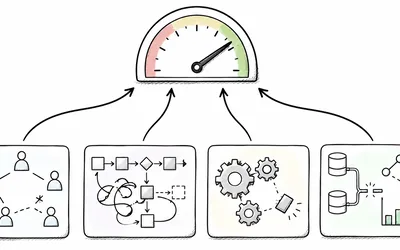
A martech renewal earns its premium only when your team will perceive the improvement in daily work. Human perception has a threshold, and the larger your existing stack, the bigger an upgrade must be before anyone notices it. Judge the change against that threshold, not against the demo.
Key Takeaways
- The just noticeable difference, the smallest change a person can detect, decides whether your team will feel a martech upgrade at all.
- Weber's insight: the perception threshold scales with your existing stack, so a large, mature setup needs a bigger improvement before anyone notices.
- Vendor improvements are real; at renewal your job is judging whether the improvement clears your team's threshold, not whether it exists.
- Reality check: a good demo runs on a clean, empty base, so it clears a lower bar than your live workflow ever will.
The upgrade that looks great in the demo and disappears at your desk
You’re up for renewal on your digital experience platform . The vendor walks you through a sharper personalization engine: faster audience building, a cleaner rules interface, better content variant testing. In the demo sandbox it looks like a real step up, and it probably is. You renew, partly for that upgrade.
Fourteen months later, ask your team what changed. Often the honest answer is nothing they could feel. The engine got better. The daily work of building an audience, shipping a variant, and reading a result felt about the same as before. The improvement was real. It landed somewhere below the line where anyone would notice.
That gap, between a real improvement and a felt one, is the thing to get in front of before you sign. There’s a century-old idea from psychology that explains it, and it shows up in a martech renewal once you know to look.
Why a bigger stack makes improvements harder to feel
Psychologists have a term for the smallest change a person can detect: the just noticeable difference, the least you can add to a stimulus before someone notices it at least half the time (1. Wikipedia, 2026). Ernst Weber, a German physiologist working in the 1830s, found something useful about that threshold: it scales with what’s already there, instead of staying a fixed amount (1. Wikipedia, 2026).
Pick up a one-pound weight, then a two-pound weight, and the difference is obvious. You doubled it. Pick up a ten-pound weight, add that same one pound, and you’ll struggle to tell. Same pound added. Bigger starting point, so the one-pound change slips under your threshold. Weber’s student Gustav Fechner turned this into a formal law and founded the field of psychophysics with his 1860 book, Elements of Psychophysics (2. Britannica, 2026).
Here’s why that matters for a martech renewal. Your existing stack is the starting weight. If you’re running a mature setup, a customer data platform with years of built audiences, a marketing automation platform wired into a dozen workflows, then a vendor’s improvement is the one pound added to ten. It has to be large before your team feels it in the work.
Marketers already use this idea, pointed at you
None of this is exotic to marketers. Weber’s law has shaped pricing and product decisions for decades (3. Britt, 1975). Picture the detergent box stamped New and Improved! The formula really did change, and you might catch it: the clothes smell a little fresher, the whites look a little brighter. Here’s the part worth seeing. The company already knows how to make that detergent close to the best it can be, and it holds some of that back on purpose. Ship every gain at once and you spend the whole story in one season, with nothing left to stamp on next year’s box. So real improvements arrive in increments, each one announced. There’s nothing sneaky in it. A product that sells on a schedule works this way. The same instinct shows up on the shelf, where packaging is tuned bright enough to stand out without tipping into irritation (4. Simply Psychology, 2022).
When you buy martech, you’re on the other side of that same rhythm. A vendor’s release notes are its version of the label on the box: a real improvement, announced so you notice it. When the renewal arrives with another $25,000 a year attached to the changes they’ve shipped, take the changes as real. The question to carry into that conversation is simpler: did anyone on your team notice a difference in getting the work done?
Reading a demo for what your team will feel
A demo is built on a small base. One clean dataset, one tidy use case, a rep who knows every click. Against that empty background, a new feature stands out, because there’s almost nothing else in the frame. That’s the one-pound-on-one-pound version, and it’s honest as far as it goes.
Your environment is the ten-pound version. The same feature has to show up on top of everything you already run: the segments you built long ago, the journeys already firing, the reports people open every morning, and the habits your team formed over years. The feature didn’t get worse between the demo and your desk. The base it lands on got a lot heavier, so the bar to notice got higher.
So watch a demo with one question running underneath it: will this be visible on top of everything my team already touches every day?
Set your threshold before you look
The move is to decide what counts as noticeable before the vendor frames it for you, and to make that judgment a standing part of how you review the stack . Three questions, written down ahead of the demo or the renewal call.
Name the daily task that should get better. Not the platform, the task: building a segment, launching a send, pulling a report. Name who does that task, and who would feel the change. Then define what noticeable looks like in that task, in plain terms. Fewer steps. Hours back each week. A report that no longer needs a manual export.
Now you have a threshold. Judge the upgrade against it. If the improvement clears the bar you set, it’s worth the premium or the switch. If it doesn’t, the tool can still be good and the improvement can still be real, and it’s still not worth paying more or absorbing a migration to get it. The same test works for a net-new purchase, where the base is smaller and the bar to notice is lower, which is why new tools often feel more impressive than renewals do.
Start with the renewal on your desk
Take the martech renewal closest to its date. Deciding what you’d need to feel before you talk to the vendor is a smaller version of the assessment that belongs before any platform decision . Before the next vendor conversation, write one sentence: what will change in the daily work, and who will feel it. If you can’t fill in the sentence, that’s your answer about the premium, and it’s a better conversation to open with the vendor than the one that starts with the feature list.
Frequently Asked Questions
What is the just noticeable difference in marketing?
How does the just noticeable difference apply to a martech renewal?
Should I switch martech tools for a better feature?
How do I set a perception threshold before a vendor demo?
References
- Wikipedia. (2026). Just-noticeable difference. Wikipedia. https://en.wikipedia.org/wiki/Just-noticeable_difference
- Encyclopaedia Britannica. (2026). Elements of Psychophysics. Britannica. https://www.britannica.com/topic/Elements-of-Psychophysics
- Britt, S. H. (1975). How Weber’s law can be applied to marketing. Journal of Business Research, 3(1), 21-29. https://www.sciencedirect.com/science/article/abs/pii/000768137590004X
- Simply Psychology. (2022). Just noticeable difference (JND) in psychology: Examples and definition. https://www.simplypsychology.org/what-is-the-just-noticeable-difference.html