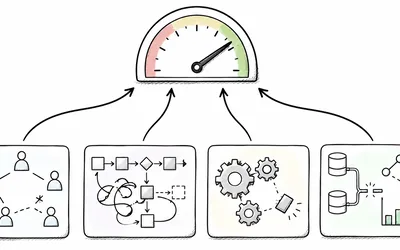
Most articles answer this with a list of iPaaS and automation tools. The better first move is to check whether you need a new platform at all. Many stacks already carry unused orchestration, and a layer on a broken stack relocates the problem instead of fixing it.
Key Takeaways
- Every result for this question is a vendor tool list (iPaaS, workflow automation, a CDP). The list skips the decision that matters.
- Most stacks already carry orchestration nobody turned on. Check what your platforms already connect before you buy a layer to connect them.
- An orchestration layer on a misaligned stack relocates the problem to a new system you now have to govern and maintain.
- Reality check: "without rip-and-replace" can be the wrong premise. Sometimes the platform has hit a ceiling, and connecting around it wraps a bottleneck in more software.
You have a stack that grew one tool at a time. A CRM , an email platform, an analytics suite, a few point tools nobody remembers approving. They don’t talk to each other, and you’d like to fix that without tearing the whole thing out and starting over. So you go looking for a platform that sits on top and connects everything.
Search for it and you get the same answer everywhere: a list of tools. iPaaS platforms, workflow automation apps, a data layer or two. Zapier and Make for the light stuff, Workato and Tray.io and MuleSoft for the heavy stuff, a customer data platform if the real problem is data. Pick the tier that matches your budget and wire it up.
The list is fine as far as it goes. Those tools exist and they work. But the list answers a question you haven’t asked yet, and skipping that question is how you end up paying for a layer you didn’t need.
The tool list everyone hands you
Set the categories down so they’re out of the way. There are three, roughly. Middleware and workflow automation (Zapier, Make, Microsoft Power Automate) for simple app-to-app triggers. iPaaS (Workato, Tray.io, Dell Boomi, MuleSoft) for heavier, governed integration across many systems. And a data layer like a customer data platform when the real problem is that customer data lives in six places and none of them agree.
That’s the whole roundup, and every article that ranks for this question gives you some version of it. What none of them give you is the part that decides whether any of it is a good idea.
Do you even need a new platform?
Start here, because the answer is often no.
Most stacks already carry more orchestration than anyone uses. The platforms you own shipped with native integrations and connectors that were never turned on. The CRM already talks to the email tool if someone flips the switch. Before you buy a layer to connect your tools, find out how much of the connecting your tools already do.
A privately held consumer goods company, somewhere in the $75 to $100 million range, came to this exact fork. Campaigns took weeks, nothing was connected, and the reflex was to buy more platforms to glue it together. The assessment found the platforms already did most of what the team needed. What was broken was how the work moved: fragmented workflows, inconsistent content models, ownership split three ways. They kept what they owned, fixed the workflow, and campaigns that took weeks now ship in days. No orchestration platform entered the picture.
Buy the layer without checking, and you’ve added a system. A new platform to license, govern, staff, and keep in sync with everything it connects to. That cost is real, and it never shows up in the roundup.
Orchestration on a broken stack moves the problem
Here’s the trap in the question itself. “Without rip and replace ” assumes the stack underneath is worth keeping. Sometimes it is. Sometimes a layer on top of a misaligned stack does nothing but relocate the mess to a new address.
If your data models don’t agree, an integration platform will faithfully pass the disagreement between systems faster. If nobody owns the customer record, adding a layer that reads from all of them doesn’t create an owner. The layer connects what you have . Fixing what you have is a different job.
So before you shop, get clear on what the layer would own versus what stays in the existing tools. If the honest answer is “it would own the parts we never sorted out,” the fix is to sort them out, and no orchestration platform substitutes for that.
When replacing is the right call
The other side of the same coin. Sometimes the premise is wrong and you should replace.
A regional retailer, $100 to $150 million, wanted to connect around a customer data platform that was straining under the load. The assessment showed the platform had hit a real ceiling. No orchestration layer was going to carry it, because the problem was the platform itself, not the connections to it. They moved to a new one, scoped to the workloads that mattered, and audience processing time was cut in half within five months. An orchestration layer would have wrapped a bottleneck in more software.
Keeping the stack is the default worth protecting. Part of the read is knowing when the thing you’re trying to preserve is the thing holding you back.
How to evaluate without the vendor’s spin
If you do need a layer, the roundups won’t help you choose, because most of them are written by or for the vendors in them. A few things the tool lists leave out.
Ask each vendor to show integration with your actual stack, not their logo wall. A long list of supported apps says nothing about whether the two systems you care about connect cleanly.
Push on time-to-value against your real complexity, not the demo’s. The vendors most likely to win the demo are the ones most likely to underestimate what connecting to your environment takes.
And get the maintenance picture. Integrations break when the systems on either end change, and someone owns keeping them alive. Find out who, and what it costs, before you sign.
The tool list is the easy part, and it’s the part everyone gives you. The decision underneath it, whether you need a new platform at all, whether the stack below it is worth orchestrating, and when replacing beats connecting, is the part that determines whether the money is well spent. Answer that first . The shortlist can wait.
Frequently Asked Questions
What kind of platform orchestrates a martech stack without replacing it?
Do I need a new platform to orchestrate my existing tools?
Can an orchestration layer fix a broken martech stack?
When should I replace a platform instead of orchestrating around it?
References
- De Libero, Gene. Marketing Technology Transformation®. https://marketingtechnologytransformation.com