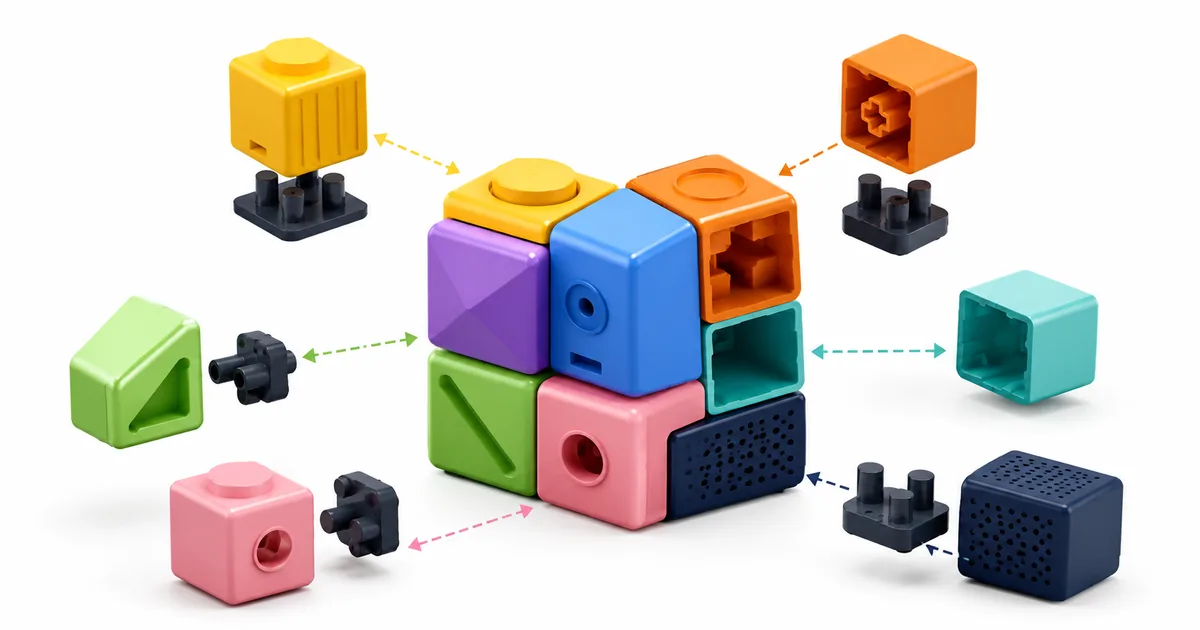
Marketing orchestration is the discipline of deciding what a connected stack does once its tools and data are unified. Composable architecture rarely fails on the technology. It fails on the org chart, where no one holds authority over what the unified stack does.
Key Takeaways
- The technology in a composable stack usually works. What fails is the org chart: no one owns what the unified tools do.
- Marketing orchestration is deciding what a connected stack does with unified data. Most teams buy the tools and skip the role.
- Naming an orchestration owner is harder than buying tools. The role needs decision rights across marketing, IT, and operations, not a standing meeting.
- The martech market has reached rough feature parity. Coordination now separates the stacks that pay off from the ones that stall.
Composable marketing projects die on the org chart. The technology works. What breaks is the decision no one is assigned to make: once your best-of-breed tools finally share data, who decides what the stack does with it? That job has a name most teams never staff. It’s marketing orchestration, and leaving it unowned is why the modular promise stalls.
I’ve watched teams treat “go composable” as a purchasing decision. Buy the headless CMS, the customer data platform, the personalization engine, wire them together, and flexibility shows up on its own. It doesn’t. Flexibility is raw material. Someone still has to conduct.
The autopsy blames the wrong thing
When a composable build underdelivers, the post-mortem writes itself. Too many vendors. Too much integration work. The pieces never clicked. Blame the plumbing. It’s a comfortable story, because it points at the architecture, which you can redo, instead of the operating model , which is harder to touch.
The evidence points elsewhere. Forrester’s latest evaluation of the digital experience platform market found the major platforms have reached rough capability parity. Nearly all of them ship content management, customer data, personalization, and automation. What separates the leaders is how well those capabilities get coordinated into an outcome (1. Forrester, 2025). Read that plainly. The tech stopped being the bottleneck. Coordination took its place.
If the technology were the problem, the companies adopting it wouldn’t keep winning with it. Composable is widely implemented now across retail, financial services, and healthcare, and in the industry’s own 2025 survey of 561 senior IT leaders, nearly nine in ten said it met or exceeded their ROI expectations (2. MACH Alliance, 2025). The tools pay off for the organizations that can run them. The same survey put the biggest barriers to getting there on the org chart: weak leadership support and IT teams that resist the change.
So when the parts all work and the market has commoditized the parts, an underperforming composable stack is exposing a coordination vacuum . The plumbing is fine. The conductor is missing.
What an orchestration decision looks like
Picture the moment composability is supposed to pay off. Your customer data platform resolves a visitor into a known segment and passes it to the personalization engine. Your commerce platform has an offer ready. Your content system holds three variants. Everything connects. Now the real question fires: which offer wins, under which rule, measured against which goal, when two campaigns want the same slot?
That’s an orchestration decision. In a suite, the platform arbitrated it for you with a built-in default. Composable strips the default out and assumes someone on your side will make the call. When no one owns that call, each tool does something locally reasonable and the customer gets an incoherent experience assembled by accident.
Composability changes who owns the roadmap
In a suite, the vendor makes a lot of your decisions for you. They set the roadmap, own the integrations, and hand you a system that already agrees with itself. Composable takes that away. As a team of Slalom consultants put it, moving to a composable martech architecture is a shake-up of product ownership, and most organizations aren’t ready for it. The roadmap is now theirs to define. In a suite the vendor did that quietly; composable hands the job back (3. Slalom, 2025).
The same group names the risk without flinching. The biggest danger in a composable architecture is integration failure, and without someone governing how the tools connect, technical debt accumulates until it drags on everything (3. Slalom, 2025). That reads like a technical warning. It’s a staffing one. “Someone governing” is a person. A role. A line on the org chart.
The org chart is the real architecture
Go composable and three things have to change, and none of them are technical . Your governance model has to change. Your team structure has to change. The way marketing, IT, and operations decide things together has to change. Skip that and you’ve bought modular tools and bolted them onto a decision process built for a monolith.
The engineering firm EPAM put the failure mode plainly. Teams assume that if they build the composable architecture, the right way of working will follow. It won’t, and the result is overruns, stalled programs, and a half-built stack that’s part monolith, part modular, coherent as neither (4. EPAM, 2023). Their prescription is governance: a body with authority to make the cross-cutting calls, so individual tool owners stop optimizing their own corner while the customer experience fragments.
The pattern sharpens as AI agents enter the stack. When Contentstack surveyed 621 enterprise digital leaders in 2026, 42% said the lack of a clear internal owner had directly delayed an AI initiative in the past year (5. Contentstack, 2026). Their own report is blunt about the cause: if this were a technology problem, it would be easier to solve. The harder problem is the ownership, the structures, and the coordination required to put the tools to work. Every agent and integration you add raises the coordination bill. Add them faster than you build the authority to govern them, and the stack runs ahead of anyone’s ability to steer it.
Name the conductor before you buy the orchestra
Here’s the move most teams skip. Before the architecture, before the vendor demos, decide who owns marketing orchestration. That role holds authority over what the connected stack does: which data drives which decision, which experience fires for which segment, what happens the moment the pieces can finally talk to each other. It’s a different job from administering the tools, and it’s senior.
That person needs real decision rights , the kind a standing meeting can’t confer. They need a mandate that crosses the marketing, IT, and operations line, because orchestration decisions cut across all three. And they need to exist before the contracts are signed. A stack assembled without an owner organizes itself around whoever shouts loudest, which is how you end up paying platform prices to run a glorified publishing tool.
Composable is still the right direction. The modular stack is more adaptable than a monolithic suite, and the market is moving there for good reasons. But flexibility you can’t govern is a more expensive way to stay stuck. The teams that win with composable share one move. They decided, out loud and early, who conducts. Draw that box on the org chart first. The technology is the easy part.
Frequently Asked Questions
What is marketing orchestration?
Why do composable martech projects fail?
Who should own marketing orchestration?
Is composable architecture worth it?
References
- Forrester. (2025). Announcing The Forrester Wave™: Digital Experience Platforms, Q4 2025. Forrester. https://www.forrester.com/blogs/announcing-the-forrester-wave-digital-experience-platforms-q4-2025/
- MACH Alliance. (2025). 2025 Global Annual Research Report. MACH Alliance. https://machalliance.org/newsroom/press-release-2025-global-annual-research-report
- Brooks, W., Black, A., & Schroer, C. (2025). Beyond the build: Why product ownership is the key to composable success. Slalom. https://medium.com/slalom-blog/beyond-the-build-why-product-ownership-is-the-key-to-composable-success-14821eb521b7
- EPAM. (2023). Beyond composable technology: Maximizing value with a composable operating model. EPAM. https://www.epam.com/insights/blogs/beyond-composable-technology-maximizing-value-with-a-composable-operating-model
- Contentstack. (2026). The 2026 Agentic Enterprise Report. Contentstack. https://www.contentstack.com/resources/report/agentic-enterprise-report-2026