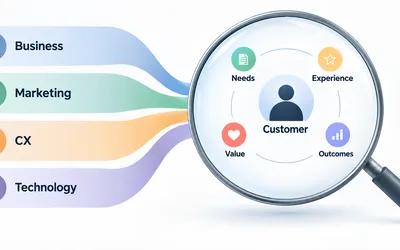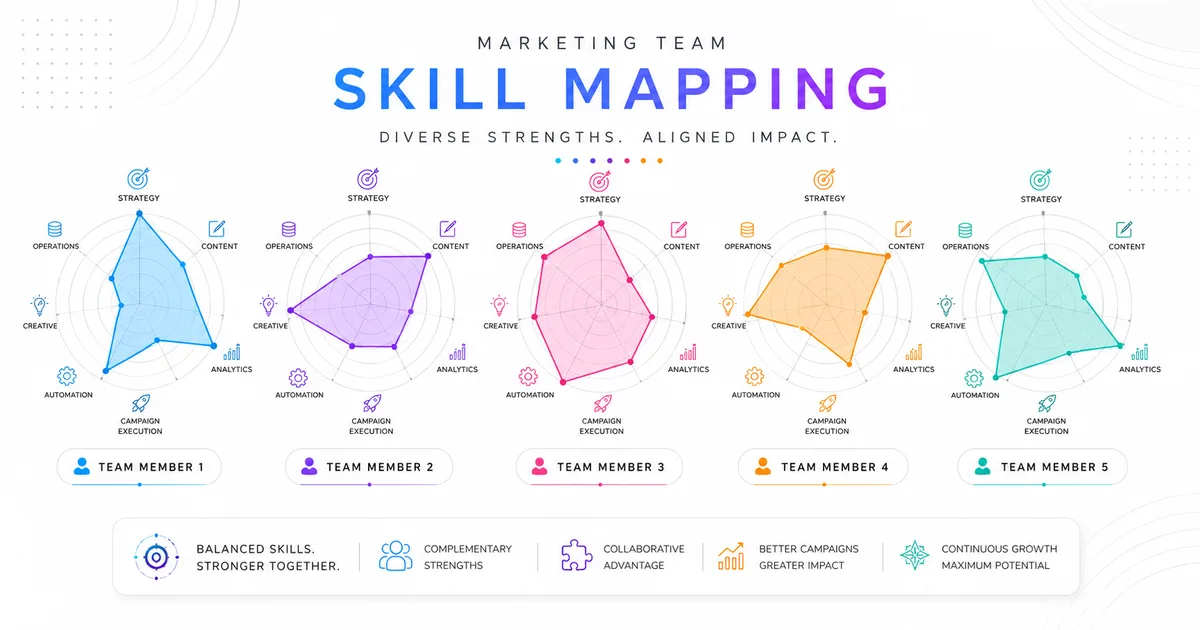
A marketing capability assessment maps what your team can do across six operational areas before you evaluate your platforms. Most CMOs skip this step and replace technology that would have worked if the team had been equipped to use it.
Key Takeaways
- Skill mapping has been standard in HR and UX for decades; marketing teams rarely do it, which is why technology investments keep disappointing.
- Your team's capability shape reveals where strengths concentrate, where single points of failure hide, and where gaps cascade into downstream failures.
- Some capability gaps close with internal mentoring; others require external hiring. Knowing which saves months of wasted effort.
- Mapping capability before evaluating technology changes the question from "which platform should we buy" to "can we use what we already own."
Where Skill Mapping Started and Why Marketing Skipped It
In 1973, Harvard psychologist David McClelland published a paper that changed how organizations think about workforce capability. McClelland argued for criterion-referenced testing: assess what people can actually do in the role rather than what they score on an aptitude test (1. McClelland, 1973). That paper launched the modern competency movement, and HR departments and I-O psychologists built frameworks around it over the following decades. By the 2000s, UX teams had adapted the concept into skill mapping, using radar charts to show where individual and team capabilities concentrated across disciplines. UX pioneers like Don Norman and Jakob Nielsen built usability practices where team capability assessment was foundational to how work got staffed and structured.
Marketing never picked it up.
Marketing leaders evaluate their technology instead. They audit platforms, compare feature sets, benchmark against competitors’ stacks. When performance disappoints, they replace vendors. The question is always “what should we buy?” and almost never “what can our team do with what we already own?”
The consequences show up in workforce data. Two-thirds of managers and executives report that their most recent hires weren’t fully prepared for their roles, with applied experience the most common gap (2. Deloitte, 2025). In marketing specifically, 56.9% of practitioners identify performance marketing skill deficiencies on their teams (3. Marketing Week, 2025). Those gaps are real. The question is why they persist. The answer sits in the sequence: marketing organizations evaluate their technology before they evaluate their team. They invest in platforms without mapping the capabilities required to operate them.
What Capability Shape Reveals
Skill mapping produces a visual: typically a radar chart showing where a team’s strengths concentrate and where coverage drops. That shape tells a CMO more about their technology’s performance ceiling than any vendor demo.
Six operational areas define the diagnostic lens: People, Processes, Data, Content, Automation, and Measurement. These aren’t a clean partition. Content lives inside Data systems. Automation spans People and Processes. Measurement instruments the other five. The overlap matters. You treat them as distinct areas because daily execution fails in specific places, and specific places need specific remediation.
Three scenarios make capability mapping urgent.
Inherited teams. A new CMO walks into an organization they didn’t build. The team composition reflects someone else’s priorities, someone else’s hiring philosophy, someone else’s understanding of what the stack required. Without a capability map , it takes months of observation to understand what the team can deliver. A structured assessment produces that picture in weeks.
Pressure hires. Positions filled fast to cover gaps. The hire who runs campaigns can’t build behavioral segmentation logic; the analyst who builds dashboards can’t connect marketing activity to revenue. Each person can do the job they were brought in for. The gap sits between their current capabilities and what the technology demands.
Hidden strengths. Someone on the team consistently solves problems others can’t, but their manager doesn’t see the full picture. Without a structured way to surface individual capability, those strengths stay invisible. The team keeps hiring externally for skills that already exist internally.
Capability mapping also exposes single points of failure. When one person carries all the expertise in a critical area and the rest of the team can’t operate independently, that’s fragility. If that person leaves, the capability leaves with them. Mapping makes concentration visible before it becomes a crisis.
The gaps themselves carry a diagnostic distinction that matters: some are trainable, some aren’t. If someone on the team already operates at a high level in a given area, they can mentor others. The gap closes internally. When nobody on the team has depth in a critical capability, no amount of internal development bridges it. That gap requires an external hire or outside expertise. Knowing which type of gap you’re facing changes your investment entirely.
Why the Sequence Matters
Capability gaps don’t stay where you find them. A People gap in behavioral segmentation skills breaks the Processes that depend on those skills. Broken processes produce unreliable Data. Bad data cripples Automation because behavioral triggers misfire when the underlying information is wrong. Automation failures starve Content distribution. And when Content can’t reach the right audience, Measurement loses the signal it needs to prove anything worked.
Fix one area without understanding this chain and you don’t fix the system. You surface the next constraint. Build the skills your team lacks, and your processes immediately expose bottlenecks that were invisible before. That’s progress, but it doesn’t feel like it unless you mapped the full chain before you started.
The sequence is: map your team’s capability shape first. Identify where the gaps are, whether they’re trainable or require external capability, and how they connect across operational areas. Then evaluate your technology.
That order changes the fundamental question from “which platform should we buy” to “can our team use what we already own?” Most organizations get this backward. They evaluate the stack, find it disappointing, and replace platforms. The new platform inherits the same capability gaps. Performance disappoints again. The cycle repeats until someone finally asks whether the problem was ever the technology .
Frequently Asked Questions
What is a marketing capability assessment?
How is skill mapping different from performance reviews?
What are single points of failure in a marketing team?
How do CMOs tell the difference between a platform problem and a capability gap?
Can all marketing capability gaps be fixed with training?
References
- McClelland, D. C. (1973). Testing for competence rather than for “intelligence.” American Psychologist, 28(1), 1-14. https://pubmed.ncbi.nlm.nih.gov/4684069
- Deloitte. (2025). 2025 Global Human Capital Trends: Closing the experience gap. https://www.deloitte.com/us/en/insights/focus/human-capital-trends/2025/closing-the-experience-gap-through-talent-development.html
- Marketing Week. (2025). Marketing leaders on bridging the skills gap. https://www.marketingweek.com/marketing-leaders-on-skills-gap