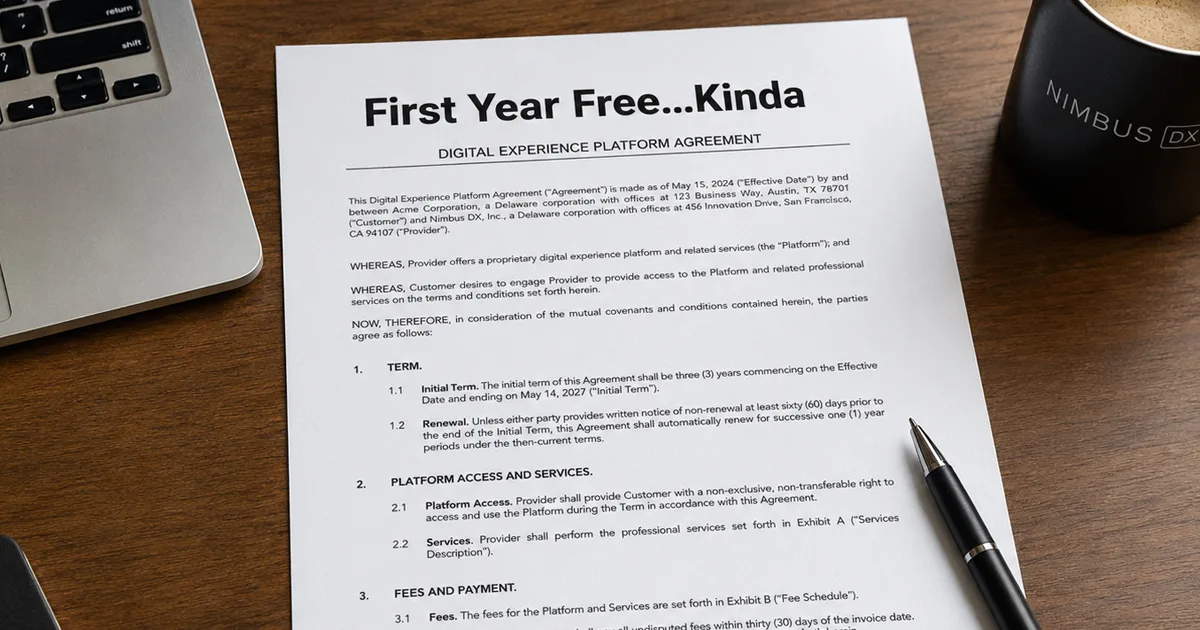
Vendor ‘free first year’ migration offers bundled with multi-year contracts evaporate when migration timelines absorb most of the discount window. The math only works when your migration beats the vendor’s own published timeline, and most enterprise migrations don’t.
Key Takeaways
- Vendor-published migration timelines typically consume most of the free year before any production traffic touches the new platform.
- Multi-year contract requirements convert one-year discounts into multi-year lock-in you cannot easily renegotiate from at renewal.
- Independent platform assessments place real enterprise migration timelines well above what vendors publish in their optimistic case.
- Reality check: most of these offers aren't bad deals. The framing is. Run the math against your partner timeline before procurement signs anything.
The pitch sounds great. A vendor offers to cover your first year of licensing if you sign a multi-year contract. Procurement loves the headline. Your CFO loves the headline. The press release writes itself.
The current live example is Optimizely’s SiteSwitch program, which covers Year 1 if you sign a 3-year CMS contract before June 30, 2026 (3. Optimizely, 2026). The pattern repeats whenever a vendor needs to clear pipeline against a competitor’s installed base. The deadline is calendrical. The structure is universal.
Then someone has to run the migration.
This is where the deal stops looking like savings and starts looking like a multi-year commitment with a marketing wrapper. The math the vendor doesn’t put on the slide is the math MOps leaders have to put in front of their boss before procurement signs anything. Run the sequence below, in order. Each step depends on the one before it.
The Vendor’s Own Number
Vendors selling migration also publish migration timelines. Those timelines are the optimistic case, the well-supported one, the case the vendor wants front-and-center. For Optimizely, that case is “most enterprise migrations with Optimizely are completed in six to nine months, even across complex, multi-site environments” (1. Optimizely, 2026). The featured success story is Cherry Bekaert, which “migrated more than 2,800 pages and launched their new site in approximately eight months without losing traffic” (1. Optimizely, 2026).
This is the number to write down. Not the partner’s slide. Not the analyst summary. The vendor’s own published case, because anything your implementation partner promises faster than that needs receipts.
A few outlier partners advertise 8 to 12 weeks for fixed-scope migrations on structured estates. Those exist. They are not the median, and they require the kind of clean content inventory most legacy CMS tenants have not maintained. If your partner’s timeline sounds aggressive, ask which Cherry Bekaert they have replicated and how.
What That Range Does to “Free”
Run the arithmetic on the SiteSwitch case to see how this plays out in practice.
A 9-month migration consumes 75 percent of the free licensing window before any production traffic touches the new platform. At the optimistic 6-month end, you’ve still burned half. The free year was never twelve months of value; it was the residual after migration overhead.
I’ve seen customers ask the vendor to postpone activation until migration completes. There’s no public traffic during the migration, so why not? The answer is revenue. The contract goes on the books at signing, and too many vendors (rightly) won’t do the kind of funky accounting that gets everybody in trouble with auditors. The free year starts when the contract starts. Go-live arrives later.
The overhead doesn’t stop at go-live. Most enterprise teams run parallel for some period, paying for the legacy platform while standing up the new one, validating integrations, and migrating the long tail of content nobody wanted to touch in the discovery phase. Add training, change management, and a post-launch optimization buffer where the team learns the new authoring model. None of that is on the vendor’s slide.
Now anchor against an independent number. The DXP Scorecard, an independent platform evaluation reference, puts typical Sitecore XP migration projects at “12 to 18 months, $500K to $2M+ for large enterprises” (2. The DXP Scorecard, 2025). That gap, between the vendor’s six-to-nine-month optimistic case and an independent 12-to-18-month reality, is the spread your CFO will eventually see in the actuals.
The free year doesn’t disappear. It gets eaten.
What Multi-Year Contracts Buy the Vendor
The pattern is older than enterprise software. Signed a multi-year wireless contract for a “free” phone? Same architecture: front-loaded discount, back-loaded lock-in, compounding switching cost. The free year is the bait. The multi-year commitment is the structural shift, and it deserves more procurement attention than it usually gets.
Year 1: free licensing.
The remaining contract years: full price, contractually committed, while your content is migrated, your integrations are rebuilt, your team is trained, and your switching cost has moved from the vendor’s balance sheet to yours. By renewal, you’ve absorbed every dollar the vendor saved you in Year 1 and you’re negotiating from inside the platform you’d have to leave to renegotiate.
That’s the vendor pulling the discount forward to fund the back half of the contract. Maintaining exit options requires building flexibility into your review process before the lock-in compounds.
The pain pattern that pushes buyers toward these offers is usually real. Sitecore complexity is the current driver: proprietary development frameworks that require certified specialists for routine content changes, opaque licensing economics, and roadmap volatility that has shifted multiple times since 2020 (4. Bejamas, 2025). Add platform end-of-support pressure, with Sitecore XP 10.4 mainstream support ending December 31, 2027 (5. Fishtank, 2026), and the urgency is legitimate. So is the temptation to grab the deadline-anchored offer in front of you.
But replacing one form of lock-in with another, on a multi-year contract signed in a hurry to catch a deadline, is the same deal in different packaging.
Three Questions for the Implementation Partner on Day One
If procurement is going to sign anything, these three questions go to the implementation partner before the SOW gets initialed.
First: “What is our actual go-live date based on our content estate, our integrations, and our team capacity, not your standard slide?” Force a partner-specific timeline anchored to your environment. If they refuse, or if the answer matches the vendor’s marketing range without adjustment, you don’t have a partner; you have a reseller.
Second: “What is our parallel-run cost between contract signing and go-live, and who owns it?” The legacy-platform-licensing-overlap window is real. Training time is real. Change-management cost is real. Name the dollar figure before signing. If your partner can’t quantify it, they haven’t run a comparable migration recently.
Third: “What is our exit cost in month 18 if this isn’t working?” Ask it knowing the answer is uncomfortable. If the partner can’t give a credible number, your negotiating position is already gone, and you haven’t even gone live yet.
The deal isn’t bad. The framing is.
For the record: I worked at Sitecore for a few years. I’m not bashing them, and I’m not carrying water for Optimizely. I’m vendor-agnostic. The only horse I have in this race is the buyer’s, and the buyer wins when the math survives a procurement review.
I specialize in otherwise: the situations where standard vendor incentives have already failed the reality test, and the math that doesn’t fit on a slide turns out to be the math that matters. Run your own numbers before you sign someone else’s.
Frequently Asked Questions
Are 'free first year' migration offers good deals?
How long does an enterprise CMS migration take?
What's the catch with multi-year migration contracts?
Should we let a vendor's deadline drive our migration timeline?
References
- Optimizely. (2026). Migrating from Sitecore to Optimizely smarter with Opal AI. https://www.optimizely.com/insights/blog/leaving-sitecore/
- The DXP Scorecard. (2025). Sitecore XP Review and Scorecard. https://www.dxpscorecard.com/platform/sitecore-xp
- Optimizely. (2026). Burned by Sitecore? Time for a SiteSwitch. https://www.optimizely.com/vs-sitecore/
- Bejamas. (2025). Is Sitecore Still a Valid Choice for CMS in 2025? https://bejamas.com/blog/is-sitecore-still-a-valid-choice-for-cms-in-2025
- Fishtank. (2026). Sitecore 2026 Support Changes: Version-by-Version Breakdown. https://www.getfishtank.com/insights/sitecore-support-changes-for-2026-version-by-version-breakdown