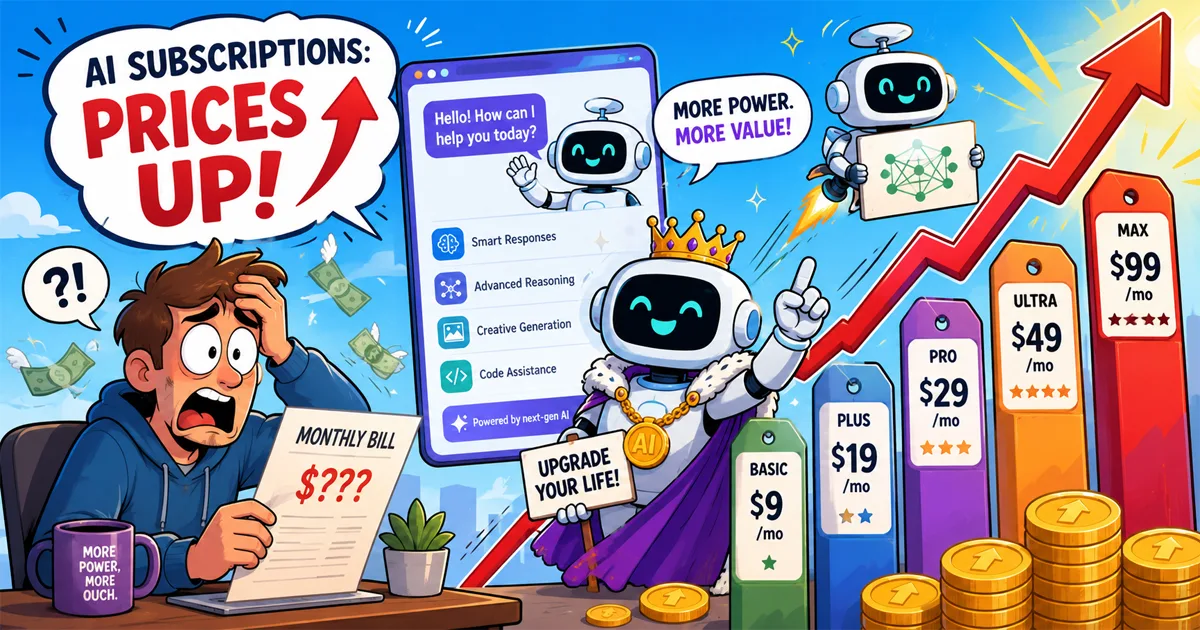
AI pricing increases follow the same penetration-to-extraction arc as Netflix, Adobe Creative Cloud, and Uber. The price hike isn’t the risk. Jumping into AI with an organization that was never built to use it is.
Key Takeaways
- AI companies subsidized growth to own the market, then raised prices: the exact playbook Netflix, Adobe, and Uber ran before them.
- 80% of AI projects fail, and the root causes are overwhelmingly organizational, not technical or financial.
- Most companies generate no meaningful value from AI at scale; the price of tokens isn't what's holding them back.
- Before you worry about what AI costs, worry about whether your data, governance, and problem definition can support it.
Everyone’s Got to Get Paid
A recent piece in The Verge frames AI’s pricing trajectory as ominous: investors poured hundreds of billions into AI infrastructure, the free tier is disappearing, and users are about to feel the squeeze (1. Field, 2026). The tone suggests something unprecedented is unfolding, that rising AI prices represent a betrayal of the early promise.
Rising prices are the most predictable move in business.
When was the last time you walked into a grocery store and got your groceries for free? Someone built the store. Someone stocked the shelves. Someone kept the lights on. Everyone’s got to get paid. AI is no different.
You’ve Seen This Movie Before
Netflix launched streaming at $7.99 a month in 2011. At that price, it was practically giving the service away, absorbing losses to pull subscribers from cable and DVD rentals. The company raised prices over the next decade: $8.99 in 2014, $12.99 in 2019, past $15 by 2022. By 2026, the Premium tier sits at $24.99 a month. Every price hike drew complaints. Subscribers kept growing anyway.
Adobe pulled the same move in a different market. In 2013, Creative Suite cost $2,600 for the Master Collection, a one-time purchase that most customers upgraded every 3 to 4 versions. Adobe killed the perpetual license and moved to Creative Cloud subscriptions starting at $9.99 a month. A Change.org petition collected more than 50,000 signatures. Stock analysts questioned the timing. Pundits predicted disaster. Today the top-tier Creative Cloud Pro plan runs $69.99 a month, Adobe’s revenue went from $4.4 billion to $19.4 billion, and the market cap increased fivefold (2. Monetizely, 2025).
Uber subsidized rides with venture capital money until the fare was cheaper than a taxi. Once the market was locked in, fares climbed, surge pricing became routine, and fees multiplied. Same playbook. Different logo on the receipt.
The pattern is identical: price low to capture the market, build switching costs , then extract value. Business school calls it penetration pricing . Practitioners call it business as usual.
The Price Isn’t What Kills AI Projects
Here’s where the Verge narrative misses the target. The article frames rising AI costs as the central threat: token prices climbing, enterprise tiers getting more expensive, third-party tools getting restricted (1. Field, 2026). All true. All beside the point.
RAND Corporation interviewed 65 experienced data scientists and engineers and found that more than 80% of AI projects fail, roughly twice the failure rate of non-AI IT projects. The study identified 5 root causes. Only 1 is primarily technical: inadequate training data. The other 4 are organizational: business stakeholders misunderstanding what problem AI should solve, teams choosing technology based on hype instead of fit, organizations lacking infrastructure to deploy completed models, and AI being applied to problems beyond current capabilities (3. RAND Corporation, 2024).
The most common root cause, according to the practitioners RAND interviewed, was business leadership failing to set the project on a path to success from the start.
I’ve watched this pattern play out for 30 years across marketing technology implementations. The technology changes. The failure mode doesn’t. Organizations buy platforms they can’t operate, skip the capability assessment , and blame the vendor when results don’t materialize. AI is running the same script with bigger numbers.
None of those failures trace back to what tokens cost.
BCG surveyed more than 1,250 firms worldwide and found that only 5% are achieving AI value at scale (4. BCG, 2025). Gartner predicts that through 2026, organizations will abandon 60% of AI projects unsupported by AI-ready data (5. Gartner, 2025).
The organizations spending the most time worrying about AI pricing are the same ones that haven’t solved the problems that cause AI projects to die.
The Invoice Isn’t Your Problem
AI prices are going up. They were always going to go up. The venture-subsidized era was a market capture strategy, not a sustainable business model, and anyone who’s watched Netflix, Adobe, or Uber already knows how this ends.
The harder question is whether your organization is built to use AI at all. Whether your data foundation can support it. Whether your teams have defined the problems AI should solve or whether they’re chasing the technology because everyone else is. Whether your governance can handle models making decisions that used to require human judgment.
Those are the problems that sink AI investments. The invoice is a rounding error next to the cost of deploying AI into an organization that can’t use it .
What does Monday morning look like? Three steps. No transformation roadmap required.
- Assess your team’s capability to use what you’re buying. Not the platform’s capability. Your team’s. Can the people operating your AI tools explain what the tools are doing and why? If the answer requires vendor help, you’ve found the gap that no pricing model can fix. Platforms amplify existing capability. They can’t generate it.
- Audit your data foundation before you add another tool on top of it. Brooks Running didn’t unlock performance by buying new platforms. They got serious about the data feeding the platforms they already owned. Most organizations skip this step because data work isn’t exciting. It’s also why their AI implementations produce garbage outputs from garbage inputs.
- Name the specific business problem AI is supposed to solve. Not “improve efficiency” or “drive innovation.” Those aren’t problems, they’re bumper stickers. A real problem sounds like “our lead scoring misclassifies 40% of MQLs” or “campaign approvals take 11 days because of manual review bottlenecks.” If you can’t name it, you’re not ready to solve it.
The price squeeze is coming. It’s also normal. The organizations that treat it as a crisis will spend the next 2 years optimizing token costs on projects that were never going to deliver value anyway. The ones that get it right will spend that time building the organizational readiness that turns AI spending into something worth paying for.
Frequently Asked Questions
Why are AI companies raising their prices?
Is the AI price squeeze similar to what Netflix and Uber did?
Why do most enterprise AI projects fail?
What should organizations focus on instead of AI pricing?
Will AI prices keep going up?
References
- Field, H. (2026). You’re about to feel the AI money squeeze. The Verge. https://www.theverge.com/ai-artificial-intelligence/917380/ai-monetization-anthropic-openai-token-economics-revenue
- Monetizely. (2025). Adobe’s Creative Cloud Transformation: From Perpetual Licenses to SaaS Pricing Dominance. Monetizely. https://www.getmonetizely.com/articles/adobes-creative-cloud-transformation-from-perpetual-licenses-to-saas-pricing-dominance
- RAND Corporation. (2024). The Root Causes of Failure for Artificial Intelligence Projects and How They Can Succeed. RAND Corporation. https://www.rand.org/pubs/research_reports/RRA2680-1.html
- Apotheker, J., et al. (2025). The Widening AI Value Gap: Build for the Future 2025. Boston Consulting Group. https://media-publications.bcg.com/The-Widening-AI-Value-Gap-Sept-2025.pdf
- Edjlali, R. (2025). Lack of AI-Ready Data Puts AI Projects at Risk. Gartner. https://www.gartner.com/en/newsroom/press-releases/2025-02-26-lack-of-ai-ready-data-puts-ai-projects-at-risk


