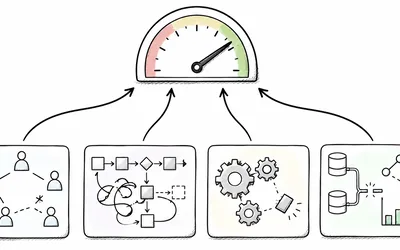
Digital maturity models don’t measure readiness for transformation. They measure compliance with someone else’s definition of progress, and that someone usually has a product to sell.
Key Takeaways
- Digital maturity models prioritize vendor agendas and arbitrary scores over meaningful business outcomes.
- The real transformation barrier is organizational alignment, not technology maturity.
- CMOs who build finance partnerships and cross-functional teams outperform those chasing maturity frameworks.
- Capability assessment beats maturity scoring because it measures what you can do, not where you rank.
Digital maturity models promise structured assessment of transformation readiness. Clean levels, tidy progressions, a sense of control. The belief rests on three pillars: that rigid scoring captures organizational reality, that the frameworks are objective, and that technology maturity predicts transformation success. Each pillar falls apart under examination.
The structured assessment collapses on contact
DMMs force-fit dynamic organizations into one-size-fits-all molds that prioritize scoring well over achieving results.
Consider a SaaS company prioritizing speed-to-market in launching new products. They’ve delayed back-end integrations to stay agile and capture market share. A DMM penalizes them for this “deficiency,” ignoring their competitive success and pressuring them to divert resources toward capabilities they won’t need for years.
Or take a global retailer with advanced AI predicting inventory demand alongside legacy CRM systems creating customer service friction. A typical DMM penalizes them for “insufficient integration” while overlooking that the AI investment delivers millions in annual cost savings.
Both organizations made deliberate strategic choices that produce business results. The maturity model can’t see the strategy. It sees gaps in a checklist. Transformation works when organizations focus on what they need to accomplish, not on climbing arbitrary milestone ladders. The structured progression the model promises is a fiction imposed on a reality that doesn’t work that way.
The scoring serves the scorer
The second pillar is neutrality. Maturity models present themselves as objective diagnostic tools. Most embed hidden incentives.
A martech-heavy DMM built by an automation vendor steers you toward investments in customer data platforms and campaign orchestration tools while overlooking simpler, high-impact changes like aligning marketing and IT. Organizations end up with expensive tools they barely use, ignoring foundational fixes that would deliver better returns.
The pattern is consistent enough to be structural. The CMO Survey Spring 2026 confirmed it: no marketing technology activity scores above mid-level performance benchmarks, and those levels haven’t improved over the past two years (3. CMO Survey, 2026). The barriers are insufficient budget, integration challenges, limited bandwidth, and talent gaps. Every one is organizational. None is a technology deficiency that a maturity model would flag.
Maturity models diagnose what their creators are equipped to sell. The actual barriers sit outside the model’s field of vision because solving them doesn’t generate vendor revenue.
Technology maturity doesn’t predict transformation success
The third pillar is the assumption that technology readiness equals transformation readiness. It doesn’t. The real barrier for most CMOs is the growing divide between marketing and finance.
The CMO’s seat at the table is eroding. Only 58% of Fortune 500 companies now have a marketing executive reporting to the CEO or sitting in the C-suite, down from 63% the prior year (1. Forrester, 2025). That erosion accelerates when CEOs frame marketing as a cost center and strip strategic authority from the function. Over one in five Fortune 500 companies changed their marketing leadership in the past twelve months. That churn reflects a credibility gap: marketing struggles to connect its work to financial outcomes in language the C-suite trusts.
The disconnect runs deeper than reporting lines. Only 43% of marketing leaders feel there is a shared understanding of marketing strategy with finance, compared to 61% of finance leaders who believe alignment already exists (2. Google/NewtonX/Project X Initiative, 2024). Your CFO thinks collaboration is working. You know it isn’t. When measurement systems don’t connect, every transformation initiative lacks the cross-functional support it needs to succeed.
Digital maturity models miss this entirely. They score technology adoption while ignoring the organizational dynamics that determine whether technology investments produce business results. Any honest assessment of transformation readiness evaluates business goals, marketing strategy, customer experience, and technology capabilities together. Technology scored in isolation produces a number. It doesn’t produce readiness.
What replaces the belief
Three pillars down. Structured assessment doesn’t capture organizational reality. The frameworks serve their creators. Technology maturity doesn’t predict success. What works instead?
Capability assessment . Instead of scoring where you rank on an external scale, evaluate what your organization can do with its people, processes, data, and technology. The diagnostic sequence — strategic alignment, operational capability, then technology assessment — provides the structure maturity models pretend to offer. That assessment reveals gaps worth closing and strengths worth building on, without vendor influence shaping your priorities. It generates its own roadmap, grounded in your organization’s reality instead of a vendor’s methodology.
Build CFO partnership before investing in another platform. Establish shared KPIs that connect marketing activities to financial outcomes: customer lifetime value , incremental revenue, contribution to pipeline. Joint planning sessions, shared dashboards, and speaking the language of finance opens budget conversations and strategic influence that no maturity score delivers.
Create cross-functional teams, not departmental silos. Pods that include marketing, IT, sales, and analytics working as unified teams can pivot when conditions change because alignment is built into the structure, not imposed by a framework.
The trade-off worth naming: abandoning maturity frameworks means losing the structured roadmap they provide. Some organizations need that structure, especially those early in transformation with limited internal capability to set priorities independently.
Apply the Vendor Agenda Test to whatever replaces the model: who benefits most if you follow this recommendation? Pull up your transformation roadmap. For each initiative, answer without hedging: “If we execute this perfectly, what specific revenue or customer outcome improves, and by how much?” If you can’t answer with numbers the CFO would accept, the initiative serves someone else’s priorities.
Frequently Asked Questions
Are all digital maturity models biased toward vendors?
What should I measure instead of maturity scores?
How do I build a stronger partnership with my CFO?
What replaces a maturity framework for guiding transformation?
Why do most transformation initiatives fail?
References
- Bruce, I. (2025). CMO fortunes falter amid economic and role uncertainty. Forrester. https://www.forrester.com/blogs/cmo-fortunes-falter-amid-economic-and-role-uncertainty/
- Google, NewtonX, & Project X Initiative. (2024). Marketing and finance: Align for growth. Think With Google. https://business.google.com/uk/think/future-of-marketing/marketing-finance-collaboration-growth/
- Moorman, C. (2026). The CMO Survey: Highlights and insights report, Spring 2026. https://cmosurvey.org/results/