Platform end-of-life is the vendor announcement that a software platform will no longer receive updates, support, or security patches after a specified date. In martech, an end-of-life announcement forces migration decisions on a timeline the organization did not choose.
Platform end-of-life is the point at which a vendor stops supporting a product, names a date after which it receives no further updates or security patches, and expects its customers to migrate.
An end-of-life announcement is a vendor telling you to leave. The language is gentler than that. There will be transition paths, migration incentives, partner programs. But the underlying message is the same: this platform has a deadline, and after that deadline, you are on your own.
For martech teams, EOL is a forced march. The organization may be mid-implementation on an unrelated initiative. The budget cycle may not accommodate a migration. The team may lack the bandwidth to evaluate alternatives, procure a replacement, and execute a transition within the vendor’s timeline. None of that matters to the deadline.
The timeline you did not set
EOL events reveal a specific kind of vendor dependency. When the platform is healthy and supported, the switching costs are theoretical. When the vendor announces end-of-life, those costs become a line item on a timeline someone else defined.
The practical challenge is that martech migrations are slow. Evaluating replacements, negotiating contracts, planning the implementation, migrating the content estate , rebuilding integrations, retraining the team: 12 to 18 months is realistic for a complex platform migration . If the vendor gives 24 months of notice, the window feels comfortable. If the vendor gives 12, the math gets uncomfortable quickly.
Vendor incentives during the transition
EOL announcements often come paired with migration offers: free licensing on the replacement product, subsidized implementation, preferential pricing for existing customers. These offers are real, but they are also designed to keep revenue within the vendor’s product family. Evaluating the offer requires the same rigor as any new procurement decision, not a faster timeline because the deadline creates urgency.
Frequently Asked Questions
How much notice do vendors typically give before end-of-life?
Can you keep using a platform after end-of-life?
Go deeper
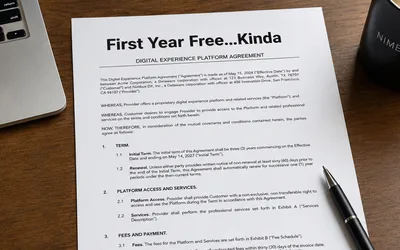
Free-Year Migration Offers: The Math Vendors Skip
Vendor 'free first year' migration offers bundled with multi-year contracts rarely pencil out against real timelines. Here's the math procurement skips.