Personalization is the practice of tailoring content, offers, experiences, or interactions to an individual based on their data, behavior, preferences, or context. Personalization ranges from basic (inserting a first name) to sophisticated (dynamically adapting an entire customer journey).
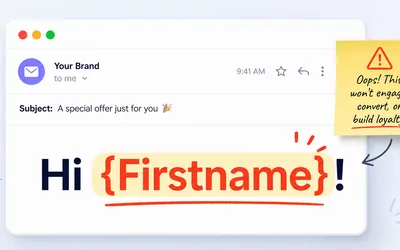
Personalization is delivering a different experience based on what you know about the person receiving it. At its simplest, it is a first name in an email subject line. At its most sophisticated, it is a website that restructures its content, offers, and navigation in real time based on the visitor’s industry, browsing history, purchase stage, and predicted intent.
The spectrum between those 2 extremes is where most organizations operate, and where most of the confusion lives.
Relevance drives engagement
Personalization works because relevance drives engagement. A product recommendation based on purchase history outperforms a generic best-seller list. A landing page that speaks to a visitor’s industry converts better than a one-size-fits-all version. An email triggered by a specific behavior (cart abandonment , pricing page visit) outperforms a batch-and-blast send.
The business case is proven across channels. The challenge is not whether personalization works. It is whether your organization can execute it with the data, technology, and processes you have.
Where personalization breaks
The first mistake is over-promising and under-delivering. Leadership buys a personalization platform expecting Netflix-level experiences. The team discovers they do not have the unified data, the content variants, or the operational workflow to deliver anything beyond basic segment-level changes. Personalization maturity is a ladder. Start with what your data can support and build from there.
The second mistake is personalizing without measuring the lift. Adding a first name to an email is personalization. But if it does not change open rates, click rates, or conversion rates compared to the non-personalized version, it is decoration. Every personalization tactic should be tested against its unpersonalized baseline. Effort without measured impact is busy work.
The third mistake is ignoring the creep factor. Personalization that reveals how much you know about someone before they are ready for it backfires. Retargeting ads that follow a customer across the internet for 3 weeks after a single site visit are personalization in the technical sense. They are also the reason people install ad blockers.
Frequently Asked Questions
What is the difference between personalization and customization?
Does personalization require a CDP?
Go deeper
Why Personalization Fails: The Consumer Promise Was Always Wrong and Your Stack Made It Worse
Gartner research shows personalization harms 53% of customers. Cart abandonment hasn't budged in five years. 70% of CMOs admit they can't scale it. Here's what the data says about the consumer promise, the execution reality, and what would work instead.

How Large Companies Keep a Vendor Update From Forcing a Stack Rebuild
A vendor update only forces a marketing stack rebuild when you built around the vendor's roadmap instead of your outcomes. What to decide at implementation.