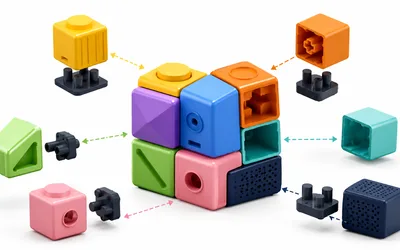
Composable architecture, a stack assembled from separate tools that each do one job, won the enterprise suite debate, according to analyst Tony Byrne. That verdict describes the market; your stack gets replaced only when evidence shows 3 of your 5 platform domains at architectural walls, or a single wall in customer data or integration.
Key Takeaways
- Tony Byrne's verdict that composable architecture won describes what large enterprises run. It can't tell you whether your own suite should go.
- The 3-of-5 threshold replaces a stack when 3 of 5 platform domains hit architectural walls, or customer data or integration hits one alone.
- A suite with no walls in your 5 domains stays: optimize it, and swap single tools where needed.
- Proving a wall is harder than claiming one. A struggling CDP can trace to content or decision-making gaps a new CDP won't fix.
What did “composable architecture has won” settle?
The suite-versus-composable argument now has a declared winner at large enterprises. Whether your stack gets replaced is still your call, made on your own evidence.
Tony Byrne runs Real Story Group, an analyst firm that advises only technology buyers. On November 4, asked who won the fight between all-in-one suites and stacks built from separate tools, he said composability won, “at least at the large enterprise level” (1. Byrne & Freedman, 2026).
His evidence comes from his own client base. Real Story Group looked at the stacks of its roughly 30 corporate members, all Global 2000 firms or close to it. Only one had gone all in on a single vendor’s suite, and that company is now pulling back (1. Byrne & Freedman, 2026). The rest run a mix: a tool from Adobe here, one from Salesforce there, connected to tools from other vendors.
Among his members, the largest companies mostly run composable architecture, a stack assembled from tools that each do one job and connect through integrations. Byrne’s finding answers one question: what a group of large companies runs.
The question for your own stack is whether the platforms you own can do what your strategy needs. The Marketing Technology Transformation® framework answers it by checking 5 platform domains: marketing automation, content management, customer data, analytics, and e-commerce. In each one, it looks for architectural walls, limits that no amount of configuration or training gets past. A stack with walls in 3 domains, or a wall in customer data or integration alone, gets replaced.
Why can’t a category verdict decide your stack?
| The market question | The stack question | |
|---|---|---|
| What it asks | Which approach do most large enterprises run? | Can the platforms you own deliver what your strategy needs? |
| What answers it | A look across many companies’ stacks | Evidence from pushing your own platforms to their limits |
| What it’s good for | Understanding where the industry went | Deciding whether to keep, fix, or replace |
Byrne’s member review answers the first question. Only evidence from your own platforms answers the second.
Vendors are also changing what they call themselves. On October 20, Salesforce agreed to buy Braze, which sends app, email, and text messages triggered by what customers do. The announcement says the companies “share a commitment to an open, composable approach” (2. Salesforce, 2026). Byrne lists Salesforce among the suite vendors. Salesforce now calls its own approach composable. The same vendor gets a different label depending on who’s describing it, so neither label tells you which platforms will do what your strategy needs. Only testing your own platforms can.
Byrne himself treats the big suites as something to test, one selection at a time. His firm still puts them on client shortlists and runs a hands-on, test-based evaluation in which, he says, they’re “very likely to lose.” He wants the loss on record as evidence, so nobody can later claim the suite would have been easier (1. Byrne & Freedman, 2026). So even the analyst who declared composable the winner decides each company’s stack by testing, not by the verdict.
What decides whether your stack gets replaced?
Your team tries to make the platform in each domain do everything your strategy needs and writes down what it finds (3. De Libero, 2026).
Your team will find 2 kinds of problems. One is a capability gap: features nobody configured, skills nobody built, workflows nobody redesigned. Those get fixed inside the platform you have. The other is an architectural wall, a limit the platform can’t get past however well your team runs it, such as processing that can’t keep up with real-time triggers.
The 3-of-5 threshold turns that evidence into a decision. Walls in 3 or more domains mean you’ve outgrown the stack and need to rebuild it, which the framework calls Path B. A single wall forces that call in 2 cases. One is a customer data platform at a wall, because every other domain runs on customer data, so bad data makes their test results unreliable. The other is integration that can’t be fixed from inside any of the platforms, where each tool does its own job, but the tools can’t share data or coordinate the way your strategy needs (3. De Libero, 2026).
The number 3 comes from how walls behave. Capability gaps stay in their own domain, so you fix them one at a time. Walls spread across a connected stack, so 3 at once usually means the connections between platforms have reached their limit, and swapping one tool won’t fix that.
Everything else means keeping the stack and getting more out of it (the framework calls this Path A). A suite with no walls in your 5 domains stays, whatever the industry decided about suites. Path A still lets you replace a single tool that hit a wall, inside the stack you have.
The threshold also stops you from counting a wall you haven’t proven. A domain counts as a wall only after your team configured what the platform already offers, took the requirement to the vendor and got a straight answer on the roadmap, and brought in outside expertise when internal skill ran out. Skip a step and what you have is an untested platform (3. De Libero, 2026). The framework counts only what your team tested. An industry verdict is a guess about your stack, so it doesn’t count.
Is the wall in the CDP?
The customer data exception is the one most likely to be misread, because a struggling customer data platform (CDP) looks like a wall before anyone has tested it.
Byrne describes enterprises that shut down their CDP after their customer data got better. Those enterprises could reach customers in more channels, but they didn’t have the content to personalize those messages or agreement on who should get which offer (1. Byrne & Freedman, 2026). The limit sat in content and decision-making, the work that happens after the data is ready.
Count that CDP as a wall and you’d rebuild the whole stack over a problem a new CDP wouldn’t solve. So before you invoke it, ask which of 2 things happened. Either the CDP failed at its own job, resolving and serving customer records at the speed your strategy needs, or the teams using its data couldn’t act on it. Only the first is a wall. The second is a capability gap in content and decision-making, and you’d have the same problem with whatever CDP you buy next.
Before the next vendor call
Open a page for each of the 5 domains and write what your team tried, what the vendor said about the roadmap, and what outside help found. Mark a domain as a wall only when all three are on the page. Then count.
Fewer than 3 walls, and neither exception, puts you on Path A whatever the verdict on suites says. The work is getting more out of what you own. The Marketing Technology Transformation® book walks through the signals that separate a wall from a gap inside each of the 5 domains. If the stack still feels broken after the count, start with how to find out why before you replace anything.
Frequently Asked Questions
Do most large enterprises run composable stacks instead of suites?
When should we replace our martech suite?
What's the difference between an architectural wall and a capability gap?
Is a failing CDP enough to justify replacing the whole stack?
Does Salesforce buying Braze change what the verdict means?
References
- Byrne, T., & Freedman, J. (2026). The Reputation Era: Who Won the Suite Wars? (Part 2). Making Sense of Martech. https://share.transistor.fm/s/b3f126db
- Salesforce. (2026). Salesforce Signs Definitive Agreement to Acquire Braze. Salesforce Newsroom. https://www.salesforce.com/news/press-releases/2026/10/20/salesforce-signs-definitive-agreement-to-acquire-braze
- De Libero, G. (2026). Marketing Technology Transformation®: Why Your Martech Stack Underperforms and How to Fix It. https://marketingtechnologytransformation.com