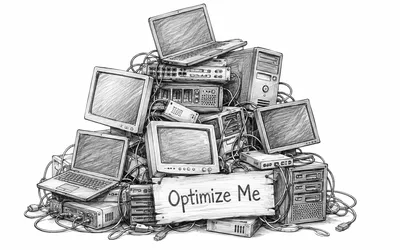
Your martech stack underperforms because your organization never built the institutional muscle to run it. The features exist. The capability to activate them doesn’t. Until reporting lines, decision authority, and operational processes change, training and platform replacement reproduce the same gap.
Key Takeaways
- Platform sophistication has outpaced the organizational capability to extract value from it.
- Training fails when reporting structures, decision authority, and daily processes stay unchanged.
- Capability gaps travel with your team to every new platform you buy.
- Structural change takes quarters, costs political capital, and most organizations choose platform procurement instead.
I have watched organizations spend millions on martech training that changed nothing. Certification programs, vendor boot camps, analytics workshops. The teams learned. Then they went back to the same approval chains, the same misaligned reporting structures, the same dashboards that track clicks instead of capability. And the performance gap held.
This is what I believe: your martech stack underperforms because the organization around it was never rebuilt to match what the platform can do. The features exist. The institutional muscle to activate them doesn’t. Training alone won’t close that gap. Neither will replacing the platform. The gap travels with you because it lives in the organization, not the technology. A diagnostic run before the platform decision is how you distinguish organizational constraints from genuine platform limitations.
That conviction didn’t come from theory. It came from watching the same pattern repeat across industries, company sizes, and platform generations for three decades. And the evidence keeps confirming it.
The Evidence Is Getting Harder to Ignore
McKinsey interviewed roughly 50 Fortune 500 senior marketers for its 2025 martech research. Not one could quantify the ROI of their martech investments (1. McKinsey, 2025). Fifty of the most resourced marketing organizations on the planet, running platforms with every feature a vendor can ship, and none could connect spend to outcomes.
The instinct is to blame the platforms. Or the integration architecture. Or the implementation partner who left before adoption took hold. That blame reflex is the single biggest obstacle to getting different results . But the platforms work fine. The features are there. What’s missing is the organizational capability to extract value from them.
The CMO Survey’s 35th edition makes this harder to rationalize away. Training budgets have fallen to 3.8% of marketing spend, down from 5.8% before the pandemic, and marketing headcount growth has dropped more than 50% from a year ago (2. The CMO Survey, 2026). Organizations rate marketing capabilities as critical. Then they defund the people and processes that build those capabilities. Budget allocation tells you what the organization prioritizes, regardless of what the strategy deck says.
Training fails because skills operate inside structures. Your MOps team learns advanced segmentation in a two-day workshop. Back at their desks, a six-step approval process means the campaign launches four weeks late. The skills are real. The process that governs execution makes them irrelevant. Decision rights sit at the wrong level, so teams can’t act at the speed the platform enables. Campaign workflows were designed for email blasts, not behavioral orchestration. Dashboards report opens and page visits while nobody measures whether the team can configure cross-channel logic or interpret data well enough to improve the next campaign.
When you don’t measure capability, you can’t manage it. And when capability gaps stay invisible, every budget cycle funds more platform licenses instead.
The Trade-Off Nobody Advertises
The prescription is straightforward. The politics are not.
Budget for the operational work that makes platforms perform. Gene De Libero’s recent analysis in MarTech quantifies what almost nobody funds: training, dedicated operations headcount, and data governance , each benchmarked against platform license costs (3. De Libero, 2026). Most organizations fund platforms as committed expenses and treat operational capability as discretionary. Flip that ratio and the math changes.
Push decision authority to the teams doing the work. If your platform enables real-time personalization but your approval chain requires a week of review, the platform’s speed is fiction. Redesign governance so operational teams own execution decisions and leadership owns strategic direction.
Measure capability alongside deployment. Track how fast your team adapts to new platform requirements. Measure whether governance enables or blocks decisions. Report how effectively functions coordinate without escalation. These metrics predict platform ROI better than feature adoption rates.
None of this is complicated to understand. It is all difficult to execute. Structural change takes quarters. It demands cross-functional authority most CMOs fight for. The results feel less tangible than a platform purchase announcement. And the gap gets worse with every capability layer vendors add. Salesforce launched Agentforce Operations in early 2026, deploying AI agents for back-office process automation (4. Salesforce, 2026). Every vendor is adding agent layers. Teams that can’t configure current platforms won’t manage autonomous agents.
Most organizations will choose procurement over organizational change . Buying a platform is a decision you can announce. Rebuilding how your team operates isn’t. I’ve watched that choice play out enough times to know it’s the default, not the exception.
The organizations that commit to structural change will compound an advantage their competitors can’t replicate by buying the same software. That’s the conviction. It’s not comfortable. But thirty years of evidence says it holds.
Frequently Asked Questions
Why does training alone fail to improve martech performance?
What's the difference between a capability gap and a platform limitation?
How much should organizations budget for martech operational capability?
How do AI agents make the capability gap worse?
What does measuring organizational capability look like in practice?
References
- McKinsey & Company. (2025). Rewiring martech: From cost center to growth engine. https://www.mckinsey.com/capabilities/growth-marketing-and-sales/our-insights/rewiring-martech-from-cost-center-to-growth-engine
- The CMO Survey. (2026). Highlights and insights report (35th ed.). Duke University Fuqua School of Business. https://cmosurvey.org/results/
- De Libero, G. (2026, April 28). The martech investment nobody budgets for. MarTech. https://martech.org/the-martech-investment-nobody-budgets-for/
- Salesforce. (2026, April 29). Salesforce launches Agentforce Operations. https://www.salesforce.com/news/stories/agentforce-operations-announcement/