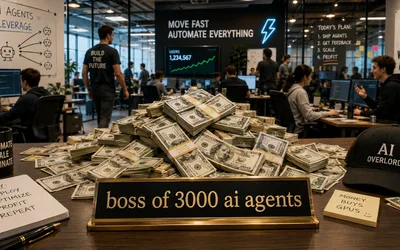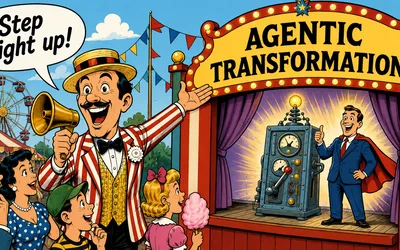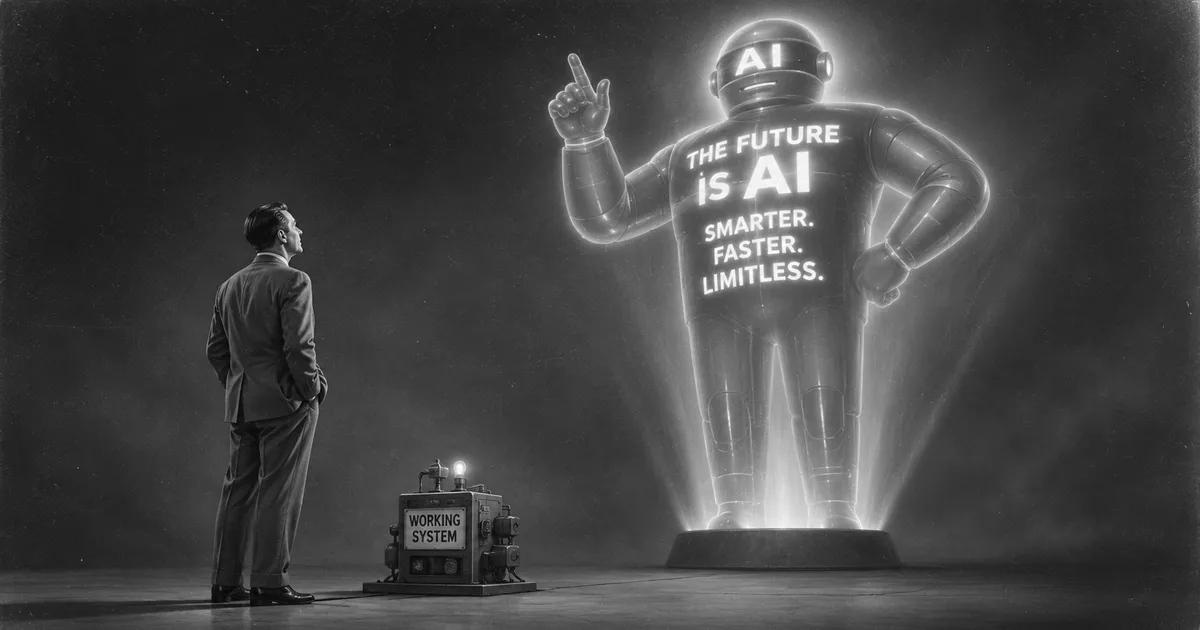
The gap between AI hype and reality starts in the CEO’s office. When AI spending is driven by peer pressure, magical thinking, and proxy metrics instead of business strategy, the resulting expectations gap costs more than the technology itself.
Key Takeaways
- The CEO's relationship with AI is the variable that accelerates or derails everything downstream, and most organizations won't say so out loud.
- Only 14% of marketing leaders say their leadership has a realistic understanding of what AI can do today.
- AI spending driven by what other CEOs are doing produces procurement as social compliance, and the marketing team absorbs the consequences.
- In organizations that measure AI adoption by token volume instead of business outcomes, demonstrating proficiency becomes a career risk.
The Variable Nobody Talks About
The CEO’s relationship with AI is the variable that either accelerates or derails everything else in the organization. When that relationship is grounded, AI investments produce returns. When it’s driven by peer pressure, magical thinking, or speed-as-value proxies, it creates an expectations gap that marketing leaders are stuck managing without the authority to close.
That gap is now measurable. Wynter surveyed 100 B2B marketing leaders at mid-market and enterprise SaaS companies in May 2026. Only 14% said their leadership has a realistic understanding of what AI can do today (1. Wynter, 2026). The rest split between leaders who overestimate AI’s capabilities and leaders who think their organizations aren’t moving fast enough. Opposite complaints from similar companies, rooted in the same cause: leaders who aren’t building with AI themselves.
Three patterns show up in organizations where that gap is widest.
When Peers Replace Strategy
In too many organizations, the CEO’s AI strategy is shaped by what other CEOs are doing rather than by what the business needs or what the team can implement. Board dinners, conference hallways, and the ambient pressure of competitor announcements replace operational data as the basis for investment decisions.
A Solvd survey of 500 CIOs and CTOs at companies with more than $500 million in revenue found that 71% say their executive leadership holds unrealistic expectations about AI’s return on investment (2. Solvd, 2025). Those expectations spring from peer pressure. AI spending has become a signal of leadership competence rather than a response to business requirements.
The cost lands on marketing. IT signs a contract for the enterprise AI platform the CEO’s peers bought. Marketing can’t use it. Marketing gets blamed for the results.
The Timeline Nobody Corrects
The second pattern is temporal. The CEO believes the transformation is underway. The marketing team is still building prerequisites: data quality , workflow design, change management , team training. The distance between those two timelines is where most AI investments go to die .
Wynter’s data quantifies that distance: most of the marketing leaders surveyed report AI hasn’t delivered ROI (1. Wynter, 2026). The top blockers among the no-ROI cohort are adoption and change management, followed by the absence of an AI strategy. The tools arrived before the organization was ready for them.
And nobody corrects the CEO’s timeline. A BairesDev survey of 501 U.S. technology decision-makers found that 79% feel pressured to overstate their AI progress to satisfy executive expectations (3. BairesDev, 2026). Nearly half say that pressure originates from the C-suite or the board. The people closest to implementation can see the gap. They can’t safely say so.
When Speed Becomes the Metric
The third pattern does the most damage. When CEOs can’t evaluate AI’s strategic impact, they default to measuring velocity. Token usage becomes a tracked KPI . “AI proficiency” gets added to performance reviews. Teams get evaluated on adoption volume instead of business outcomes.
Wynter’s survey surfaced this in respondents’ own words: monthly AI usage dashboards reviewed by managers, token consumption flagged as a performance signal, colleagues let go for “not adapting to AI workflows” (1. Wynter, 2026). The respondents describing these patterns were heavy AI users themselves. Their objection was the surveillance posture.
The calculation is brutal and predictable. When demonstrating that you completed a complex analysis in an hour invites the question “then why do I need you?”, senior marketers learn to hide their AI proficiency. They stop innovating with the tools. The signal the organization sends is clear: AI competence is a headcount risk.
And there’s a cost nobody’s measuring. Wynter’s survey surfaced it in a single quote that echoed across the dataset: heavy AI users are losing satisfaction in their work. They’ve shifted from creators to reviewers, from builders to editors of AI output. The companies tracking AI productivity aren’t tracking what AI is doing to the people producing it.
The Conversation That Can’t Happen
This expectations gap persists because the people who see it most clearly are the ones least equipped to name it. The CMO can’t walk into the CEO’s office and say “your mental model of AI is wrong” without career consequences. The CTO can’t push back on unrealistic timelines without being labeled an obstacle. So 79% of technology leaders overstate progress, most marketing leaders know the read is off, and the gap widens quarter over quarter.
The companies closing this gap share one trait: their CEO uses AI. Builds with it. Ships something real with it. A CEO who has personally wrestled a workflow into production stops asking why the transformation is taking so long. Until that happens, the expectations gap is a leadership problem wearing a technology mask.
Frequently Asked Questions
Why do CEOs have unrealistic AI expectations?
How does the CEO-CMO AI expectations gap affect marketing teams?
What is AI surveillance culture in the workplace?
How can organizations close the AI expectations gap?
What percentage of marketing leaders say their CEO understands AI?
References
- Wynter. (2026). How B2B Marketing Actually Uses AI. Wynter Research. https://wynter.com/research/ai-b2b-2026
- Solvd. (2025). CIO & CTO Insights: AI Research 2025. Solvd/Wakefield Research. https://solvd.com/research/solvd-ai-research-2025/
- BairesDev. (2026). The AI Execution Gap. BairesDev/Centiment. https://www.bairesdev.com/blog/ai-execution-gap-report