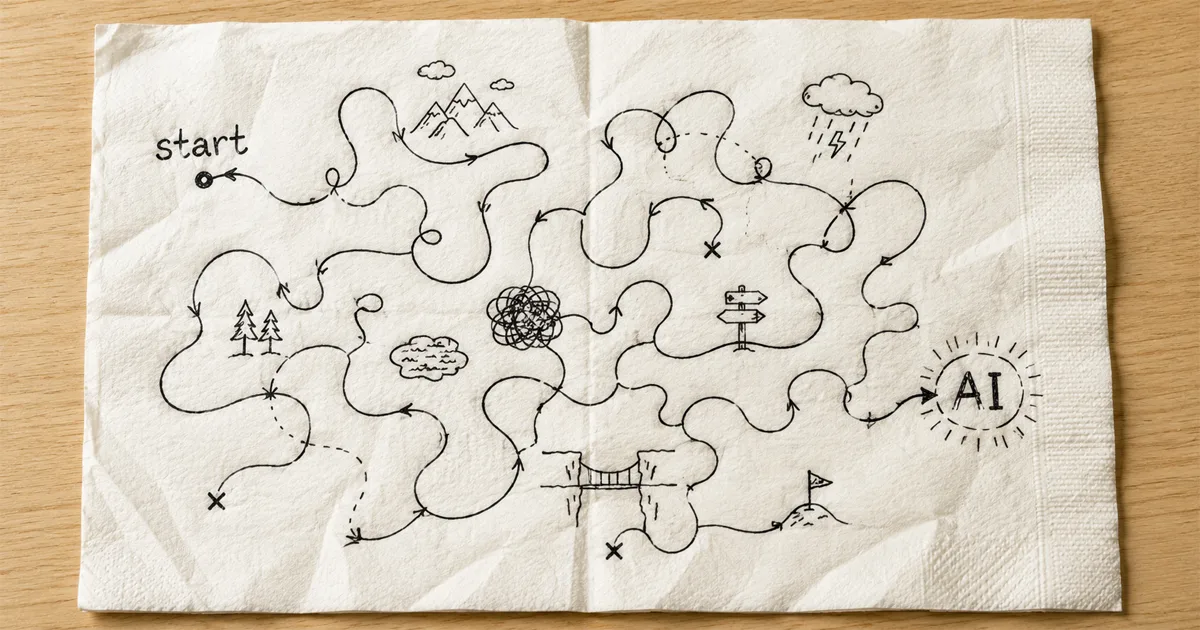
AI fatigue is a rational triage decision by marketing leaders who’ve measured the gap between AI’s promises and its operational reality. CMOs stepping back from aggressive AI adoption aren’t falling behind; they’re choosing work that delivers results over work that delivers demos.
Key Takeaways
- AI fatigue among CMOs reflects rational prioritization, not resistance to innovation.
- Nearly half of enterprise leaders now describe their AI adoption as a "massive disappointment."
- AI outputs often require as much human verification as doing the work manually, erasing promised efficiency gains.
- Stepping back from AI creates space to fix the operational problems AI was supposed to solve.
I’ve spent the last year listening to marketing leaders apologize for not moving fast enough on AI. I think they should stop.
The pressure to adopt is relentless. Board decks feature AI roadmaps. Vendor pitches promise transformation. LinkedIn feeds overflow with AI workflow screenshots from marketers who seem to have it figured out. And the CMOs who’ve quietly decided to step back from aggressive AI integration? They’re making the most rational decision available to them. They noticed something the enthusiasts missed: the results don’t match the receipts.
The Gap Between Reported and Felt
Here’s the paradox that should make every marketing leader feel better about their AI skepticism. Nearly half of enterprise leaders, 48%, now call their AI adoption a “massive disappointment,” and three quarters say their organization’s AI strategy is “more for show than substance” (1. Writer & Workplace Intelligence, 2026). At the same time, other surveys report surging ROI and expanding use cases (2. SAS & Coleman Parkes, 2025).
Both can be true. Organizations are deploying AI broadly and finding that broad deployment doesn’t equal broad value. Marketing teams can report measurable improvements in narrow use cases while their leaders recognize the overall investment hasn’t justified the disruption it caused. The gap between a metric on a dashboard and the felt experience of running a marketing organization is where AI fatigue lives. It’s the same expectations gap that nobody in the room can safely name .
That gap gets wider when the pressure to perform is artificial. Nearly eight in ten technology decision-makers say they feel pressured to overstate AI progress to leadership (3. BairesDev & Centiment, 2026). When the people building the systems feel compelled to inflate their results, the disillusionment is a measurement problem at the infrastructure level.
What Practitioners Are Telling Each Other
The clearest signal comes from what marketers say when no audience is watching.
Across forums, podcasts, and professional networks, the same pattern repeats. Marketing practitioners accept AI as a process tool. They reject the transformation narrative wrapped around it. They’ve tried the workflows, tested the platforms, and arrived at a consistent conclusion: AI generates output that requires as much time to verify and correct as doing the work yourself. The efficiency promise evaporates the moment quality matters.
One VP of Marketing put it plainly: the bottleneck inside the average marketing department was never content creation. It’s coordination, approvals, information retrieval, fragmented systems. AI accelerates content production for teams whose content production speed was never the problem. Faster execution of the wrong work is still the wrong work.
That observation keeps surfacing everywhere the conversation is candid. A head of marketing at an AI-powered SaaS company watched his sales rep close the best week of the year on 1,500 cold calls with zero AI assistance. Marketing consultants report clients who automated their entire content operation, then watched conversions drop because the output “sounded okay at first glance” but persuaded nobody. One enterprise AI leader offered the sharpest analogy: deploying AI tools to a team that hasn’t built foundational capabilities is like giving fifth graders calculators and expecting them to do accounting. The tools work. The readiness doesn’t.
The practitioners drawing this line are the ones closest to the work, making triage decisions with real budgets and real deadlines. When every AI vendor promises a step change and the lived experience is “about the same but with an extra review step,” stepping back is resource allocation.
The Triage That Builds Forward
Here’s what makes AI fatigue a strategic advantage rather than a strategic liability.
Every hour a marketing team spends implementing, debugging, and validating AI workflows is an hour not spent on the operational problems that set the ceiling on marketing performance . The coordination breakdowns. The approval bottlenecks. The institutional knowledge trapped in one person’s inbox. Those are the problems that determine whether a marketing organization functions. AI doesn’t fix them. In many cases, AI adds another system to coordinate, another output to approve, another tool that needs the institutional knowledge it was supposed to replace.
There’s a secondary benefit to stepping back that rarely makes the business case . As AI commoditizes execution, it reveals which marketing organizations had genuine strategy underneath the activity and which were substituting volume for direction. The leaders pulling back are often the ones who recognized what that exposure would show before it showed them.
The CMOs who’ve stepped back are choosing to fix the plumbing before installing a smart thermostat. They understand that a connected device adds no value when the pipes are broken.
Gartner positions generative AI in the Trough of Disillusionment, the phase where early excitement gives way to a harder look at what the technology delivers in practice (4. Gartner, 2025). Gartner’s own estimate: two to five years before generative AI reaches the Plateau of Productivity. Meanwhile, the foundational disciplines that make AI useful, things like AI engineering and ModelOps, are now ascending the Slope of Enlightenment. The infrastructure isn’t ready either. The CMOs who’ve decided to wait aren’t guessing. They’re reading the same timeline the analysts are and choosing to spend the interim on problems they can solve today. They’re getting work done with the tools and processes they already understand, fixing the problems they can see, and keeping their teams focused on outcomes they can measure.
The next time someone asks why your team isn’t further along on AI, skip the apology. You looked at the evidence, weighed it against what your organization needs, and made a call. And when the board asks for the AI roadmap, give them one: fix the coordination failures, the data quality gaps, and the approval bottlenecks that guarantee any AI deployment underperforms. Call it fatigue if you want. I call it judgment.
Frequently Asked Questions
What is AI fatigue in marketing?
Why are CMOs stepping back from AI adoption?
Is AI fatigue a temporary phase?
How should marketing teams handle pressure to adopt AI?
What should CMOs prioritize instead of AI integration?
References
- Writer & Workplace Intelligence. (2026). The enterprise AI adoption report 2026. Writer. https://writer.com/blog/enterprise-ai-adoption-2026
- SAS & Coleman Parkes. (2025). Marketers report surging ROI as GenAI moves from pilot to practice. MarTech.org. https://martech.org/marketers-report-surging-roi-as-genai-moves-from-pilot-to-practice
- BairesDev & Centiment. (2026). The AI execution gap report. BairesDev. https://www.bairesdev.com/blog/ai-execution-gap-report
- Gartner. (2025). Hype cycle for artificial intelligence. Gartner. https://www.gartner.com/en/articles/hype-cycle-for-artificial-intelligence