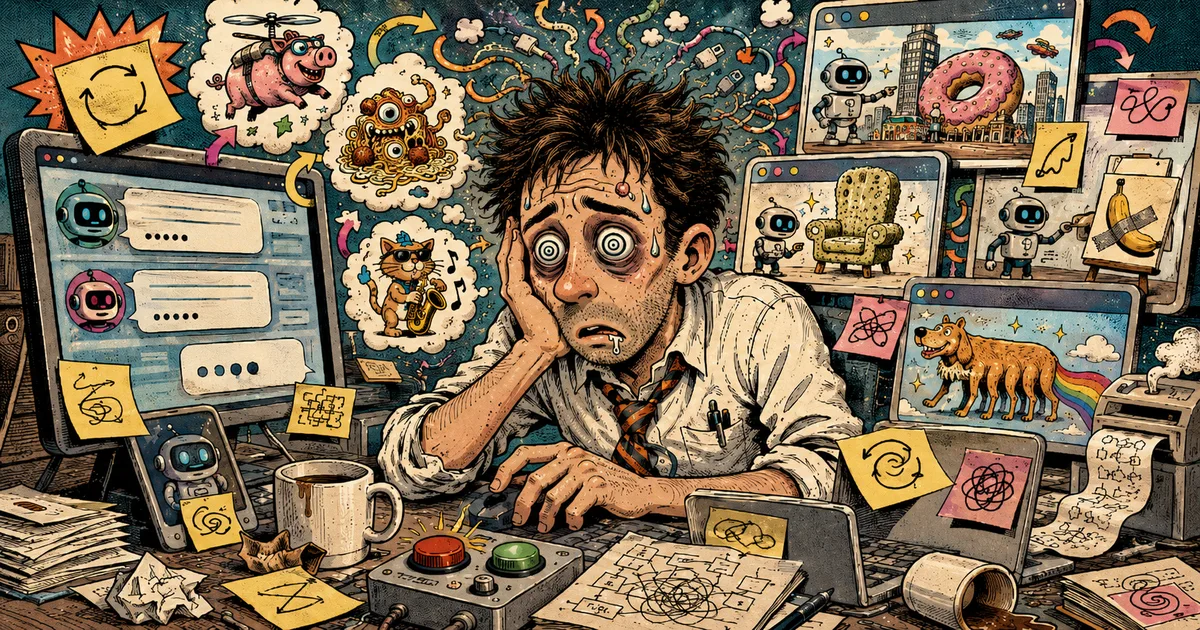
AI cognitive offloading is the habit of handing your thinking to a chatbot until the skill of thinking itself fades. Marketers are braced for AI to take the job. The likelier loss is quieter: you keep the job while the judgment you were hired for erodes.
Key Takeaways
- AI cognitive offloading erodes critical evaluation, the skill that separates a marketer from an output generator and the one needed to catch AI's mistakes.
- AI-assisted work looks finished, so the judgment gap stays invisible until a consequential decision needs a real evaluation no one can supply.
- Reality check: the marketers most at risk are the ones adopting AI fastest and least deliberately. The erosion never announces itself.
- The fix costs intent, not time: write your own answer first, interrogate the output, and use AI to sharpen judgment instead of borrowing it.
Every marketer I talk to is braced for the same catastrophe, and it’s the wrong one. The fear is that AI takes the job. Reasonable fear, and the less likely one. The outcome I’d bet on is quieter: you keep the job and slowly get worse at it, because the tool you adopted to move faster is dismantling the judgment that made you worth hiring.
The replacement story hides a second one almost no one is tracking: what AI is doing to the people it doesn’t replace. You can survive every reorg and still lose the thing you were paid for. That second story is already underway, and nobody scheduled a meeting about it.
What the research found
The evidence is piling up, and it’s physical. In 2025, researchers at MIT’s Media Lab wired up 54 people writing essays and watched their brains on EEG. The group using ChatGPT showed the weakest neural connectivity of anyone in the study, and the dampened activity lingered even after they stopped (1. MIT Media Lab, 2025). The researchers named what they were seeing cognitive debt: borrow convenience now, pay it back later in weakened thinking.
One study is a headline. A pattern is a problem. Gerlich surveyed 666 people and found the heaviest AI users scored lowest on critical thinking, with the youngest the most dependent of all (2. Gerlich, 2025). A 2026 controlled trial had developers learn a new software library, half with an AI assistant, half without. The AI group scored 17% lower on comprehension, and the widest gap showed up in debugging, the skill you need to catch what the tool gets wrong (3. Shen & Tamkin, 2026).
The first skill marketing loses
AI cognitive offloading doesn’t take skills evenly. It takes the one that matters most, first: critical evaluation. The ability to read an output, see what’s missing, and push back.
That skill is the difference between a campaign brief that launches clean and one that burns ten rounds of revision because no one questioned the direction, or an attribution read that changes a budget instead of confirming what the team already believed. For a marketer, that skill is the job. And it’s the first thing to go when the daily habit becomes prompt, skim, accept.
A Harvard field experiment caught the shape of it: consultants using AI got through more tasks, then did measurably worse on the work that required real judgment, the problems sitting past the edge of what the model handles well (4. Dell’Acqua et al., 2023). The speed is real. The judgment loss shows up later.
Why you won’t hear a marketer admit this
Here’s the tell: almost no one reports it. You’ll find endless posts arguing that judgment matters more in the AI era. You’ll find almost none where a marketer says, plainly, that their own judgment has thinned.
That silence is the mechanism working exactly as described. Losing critical evaluation also means losing the ability to notice it’s fading.
What you get instead is a moment. A manager asks a junior why the pricing recommendation is built the way it is. The work is clearly AI-assisted and fine on the surface. Pressed on the reasoning, the junior can’t explain the logic behind their own recommendation, only that the model produced it and they trust it. The junior did nothing lazy. The mental model never got built, because the step where you build it got skipped.
The judgment debt comes due
Every skipped step is borrowed against a skill you’ll need later. Your team’s AI wins are real: a competitor teardown that took six hours now takes ten minutes, a first draft that took two days now takes one. What the productivity math leaves out is that some of that speed is a loan. You bought the hours by skipping the thinking, and the thinking is where judgment gets built.
The bill arrives on a specific kind of day. An AI-generated strategy that looks complete because no one has kept the muscle to find what’s missing. A confident, wrong analysis that travels into a budget decision because the person who should have caught it can’t anymore. Individually, a bad afternoon. Across a team that adopted AI at volume without building the judgment to supervise it, an organization running on borrowed thinking, with the debt getting bigger the longer no one notices.
“Brain rot” was the Oxford English Dictionary’s word of the year in 2024, coined for what endless low-quality feeds do to a doom-scrolling brain (5. Oxford English Dictionary, 2024). The version that should worry a marketing leader has moved past teenagers on TikTok. It’s landing on senior people, on company time, with a tool they’re being told to adopt faster. A 2026 paper makes the link directly, flagging deskilling from AI over-reliance as a serious, under-examined risk, the professional cousin of the meme (6. Chalkidis & Søgaard, 2026).
Use AI to build judgment, not borrow it
The reflex is the calculator comparison. We offloaded arithmetic and survived, so this is only the next tool panic. It breaks on one point: a calculator offloads a task you can still check at a glance. AI offloads judgment, framing, and interpretation, where wrong isn’t obvious and the tool that made the error is the same one you’d use to check it.
The next reflex is that AI is a force multiplier. True, and that’s the catch. A multiplier only works on something you already have. Point it at real expertise and it extends real expertise. Point it at judgment you never built, and there’s nothing to multiply.
Some people learn more with AI, and they’re right. The difference is interaction. Interrogating an output builds the skill; accepting it wears the skill down. Cognitive psychologist Robert Bjork’s work on “desirable difficulties” explains why: the friction AI removes is often the mechanism by which understanding forms. Remove the effort and the false starts, and the learning goes with them.
So use AI like someone who intends to get sharper, not only faster . Before you prompt, write your own answer first. Read what the model gives you against it, hunting for what it assumed and left out. Ask for the three strongest arguments against its own recommendation. It costs seconds and keeps the muscle live.
Audit how you use AI this week, not whether it’s coming for your job. The job was never the real risk. Your judgment was, the whole time. Use the tool to build it, and you become the marketer who can look at an AI-generated strategy and say exactly where it breaks.
Frequently Asked Questions
Does AI cognitive offloading actually weaken critical thinking?
What is cognitive debt?
How can marketers use AI without losing judgment?
References
- MIT Media Lab. (2025). Your brain on ChatGPT: Accumulation of cognitive debt when using an AI assistant for essay writing task. MIT Media Lab. https://www.media.mit.edu/publications/your-brain-on-chatgpt/
- Gerlich, M. (2025). AI tools in society: Impacts on cognitive offloading and the future of critical thinking. Societies, 15(1), 6. https://www.mdpi.com/2075-4698/15/1/6
- Shen, J. H., & Tamkin, A. (2026). How AI impacts skill formation. arXiv. https://arxiv.org/abs/2601.20245
- Dell’Acqua, F., McFowland, E., Mollick, E. R., Lifshitz-Assaf, H., Kellogg, K., Rajendran, S., Krayer, L., Candelon, F., & Lakhani, K. R. (2023). Navigating the jagged technological frontier: Field experimental evidence of the effects of AI on knowledge worker productivity and quality. Harvard Business School Working Paper 24-013. https://www.hbs.edu/faculty/Pages/item.aspx?num=64700
- Oxford English Dictionary. (2024). Word of the Year 2024: Brain rot. Oxford University Press. https://corp.oup.com/word-of-the-year/
- Chalkidis, I., & Søgaard, A. (2026). Brainrot: Deskilling and addiction are overlooked AI risks. arXiv. https://arxiv.org/abs/2605.03512